









Operational Risk
182 results

Implementing a Digital Contactor Management System: A Panel Discussion with Customers – Webinar Discussion Summary
We recently held a webinar, Implementing a Digital Contractor Management System: A Panel Discussion with Customers, led by Global Enterprise Account Manager with VelocityEHS, Karl Ryan, to share how easy it can be to move from a paper-based contractor management system to a digital one, especially with the right software. Joining in the discussion were […]
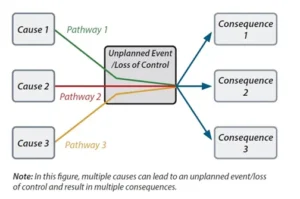
Introduction to EHS Risks, Part Four: Using Risk Bowties
Welcome to the fourth installment of our blog series “Introduction to EHS Risks,” in which we’ll talk about the ways that a tool called risk bowtie analysis can help you improve your management and communication of EHS risks. In case you missed our previous posts in this series, take a little time to check out […]

Using Risk Bowties To Manage Risk
In this eBook, we’ll teach you how a risk assessment tool called bowtie analysis can help you manage risk enterprise-wide.
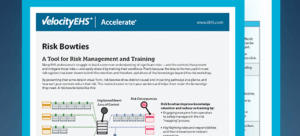
Risk Bowties: A Tool For Risk Management And Training
Download the infographic to learn how easy bowtie analysis can be.
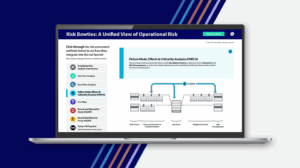
Risk Bowties: A Unified View Of Operational Risk
Download the interactive infographic and click through to see how different risk assessments tie into a risk bowtie analysis.
EPA’s Proposed Rule on Clean Water Act “Worst Case Planning”: What You Need to Know
You might have missed it among the many other proposed regulations that have come out recently, but EPA recently published a significant, new proposed rule that would require many facilities to develop plans to respond to potential “worst case discharges” of chemicals at their facility. The proposed rule builds upon EPA’s authority established in the […]
Five Tips for Implementing Better Ergonomics Controls
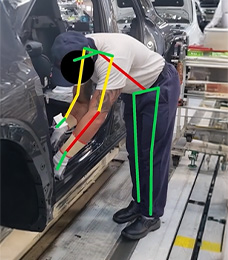
Preventing musculoskeletal disorders (MSDs) is the primary reason most organizations have an ergonomics program in place, and preventing MSDs requires identifying and implementing effective controls. Unfortunately, this is precisely the step in the process where many ergonomics teams struggle, but here are 5 impactful things you can do to improve the effectiveness of your ergonomics […]
Ergonomics Conference Session Re-Cap: How Machine Learning is Advancing Ergonomics Effectiveness
The March 2, 2022 VelocityEHS Ergonomics Conference featured a ‘dream-team’ of our very own ergonomics, industrial hygiene and EHS technology experts alongside leading ergonomics process owners from Cummins, W.L. Gore, Lear, and Southwire, who led conference attendees through a full day of sessions covering cutting edge topics in the field of ergonomics. During one of […]

Introduction to EHS Risks, Part Three: Understanding and Managing Risk Controls
Welcome to the third installment of our blog series “Introduction to EHS Risks,” in which we’ll talk about the importance of selecting and managing good risk controls. In case you missed our previous posts in this series, take a little time to check out our first installment for an overview of EHS risks, and our […]
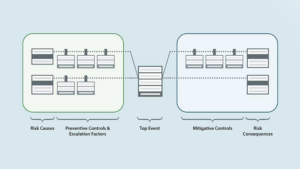
Bowties, Fault Trees and Event Tree Analysis
Bowtie analysis is a risk analysis methodology that focuses on risk interactions. We’ve covered a lot about it in our blog, but how does bowtie analysis compare to other analysis methods based on probability, like event tree and fault tree analysis? The bowtie analysis method can be based on qualitative, semi-quantitative or quantitative risk calculations. […]