










Regulations & Compliance
708 results

Web Resource: Solutions to Control Hazards by OSHA
“Solutions to Control Hazards” by OSHA contains information relevant to the implementation of control hazards in a variety of environments. There are three main groups of control hazards (engineering, administrative work practices, and PPE) that lead to the reduction of exposure to risk factors. This site provides examples, success stories, case studies, and guidelines in […]

VelocityEHS Learns from Users to Help Improve EHS Software Solutions
VelocityEHS has a lot to learn from our users. It may be as simple as the different ways an accident or incident can be defined or as complex as improving safety culture in the workplace. We spend hours listening to our users so we can better understand their needs. We then internalize this information so we […]

Bleach (Sodium Hypochlorite) Safety Tips: Bleach Safety Instruction
Sodium Hypochlorite (Bleach) Safety Information It whitens your whites, cleans your floors and acts as a great sanitizer. But bleach, (also known as its chemical name, sodium hypochlorite) can be quite hazardous when not handled properly. What Is Bleach AKA Sodium Hypochlorite? Sodium hypochlorite is a green/yellow liquid that smells like chlorine. It is a […]

Working Safely with Crystalline Silica
Safety & Care When Working with Crystalline Silica Crystalline Silica is a mineral found in the Earth’s crust and comes in several forms, most commonly in quartz; the other two forms are cristobalite and tridymite. It is so widely used in various industries that people come into contact with it literally every day. Used in […]

5 Reasons Why Managing Safety Data Sheets Electronically is Good for Business
1. Saves Time 2. Saves Money 3. It’s Efficient 4. Sustainability 5. Risk Reduction It would be easy to think that most companies choose to manage their safety data sheets (MSDSs and SDSs) electronically because they are concerned with OSHA compliance or the transition to GHS. However, the truth is, most companies choose electronic management […]

The Top 10 OSHA Violations of 2013
Today OSHA unveiled the Top 10 OSHA violations of 2013 at this year’s National Safety Council Congress and Expo in Chicago. Sponsored by Safety+Health magazine and The top ten list presentation drew a big crowd of attendees in the Expo hall. Most hazards carried over from the 2012 list, with a couple gaining ground and […]

OSHA Clarifies the Use of HMIS and NFPA Labels Under GHS Adoption, and Small Container Labeling, During Webinar on HazCom 2012
OSHA discussed the use of HMIS and NFPA labels during a Webinar on HazCom 2012 today. The main focus of the presentation was preparing employers for meeting the Dec. 1, 2013 training deadline and answering implementation questions OSHA’s received in the last year since the HazCom Standard was revised first implemented. Jennifer Lawless, directorate of […]
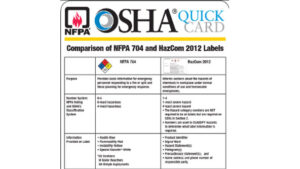
New NFPA and OSHA HazCom 2012 Quick Card
The NFPA has posted a new Quick Card to its website to help users quickly compare NFPA 704 with OSHA’s HazCom 2012. Made in partnership with OSHA, it provides side by side information about the two systems. The need for the card grew out of OSHA’s adoption of GHS in March of 2012 which concerned […]

Acetone: The Hidden Hazard
What Is Acetone? Acetone, also known as propanone, is a clear, colorless liquid that is highly flammable. It is not necessarily a household word, but this will ring a bell: nail polish remover. Acetone is also used as a degreaser, for thinning fiber glass resin, and helps remove adhesives and vinyl resins. While it is […]
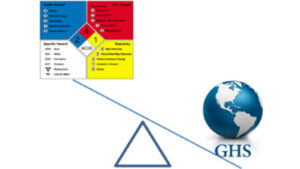
NFPA, HMIS and OSHA’s GHS Aligned Hazard Communication Standard
Now that OSHA has revised its Hazard Communication Standard to align with GHS, the big question many employers, chemical manufacturers and distributors have is, “Can I continue to use NFPA and HMIS systems and labels?” The short answer is yes. However, whether or not they should (or will even want to over the long run) […]