










Chemical Management
534 results

From the Ground Up: Supply Chain Compliance
This second post in a series on the NAEM Report, “Planning for a Sustainable Future,” focuses on the growing challenge of enforcing supply chain compliance in a tangled and constantly fluctuating regulatory environment. Supply chain compliance is an ever-evolving global issue. Unless all materials right down to chemical makeup or raw minerals are sourced locally, […]

Bleach (Sodium Hypochlorite) Safety Tips: Bleach Safety Instruction
Sodium Hypochlorite (Bleach) Safety Information It whitens your whites, cleans your floors and acts as a great sanitizer. But bleach, (also known as its chemical name, sodium hypochlorite) can be quite hazardous when not handled properly. What Is Bleach AKA Sodium Hypochlorite? Sodium hypochlorite is a green/yellow liquid that smells like chlorine. It is a […]
The Psychological Side of Ergonomics
by Matt Gilliam, AEP The physical factors of ergonomic risk can often be easily identified in the workplace. High forces and awkward postures can be observed, as well as the potentially harmful effects they have on workers (pain, WMSDs, lost time injuries). However there is another side of ergonomics worth noting: the psychological effects. Ergonomics […]

Working Safely with Crystalline Silica
Safety & Care When Working with Crystalline Silica Crystalline Silica is a mineral found in the Earth’s crust and comes in several forms, most commonly in quartz; the other two forms are cristobalite and tridymite. It is so widely used in various industries that people come into contact with it literally every day. Used in […]

Latex Painting Safety Tips: Commercial & Residential
Latex Painting Safety Tips As we continue our too-fast cruise through fall, house painting is the focus for many homeowners, particularly for those looking to place their home for sale during the robust upcoming winter market. Whether you are painting your home yourself or are a house painting contractor, we at VelocityEHS would like to […]

5 Reasons Why Managing Safety Data Sheets Electronically is Good for Business
1. Saves Time 2. Saves Money 3. It’s Efficient 4. Sustainability 5. Risk Reduction It would be easy to think that most companies choose to manage their safety data sheets (MSDSs and SDSs) electronically because they are concerned with OSHA compliance or the transition to GHS. However, the truth is, most companies choose electronic management […]

The Top 10 OSHA Violations of 2013
Today OSHA unveiled the Top 10 OSHA violations of 2013 at this year’s National Safety Council Congress and Expo in Chicago. Sponsored by Safety+Health magazine and The top ten list presentation drew a big crowd of attendees in the Expo hall. Most hazards carried over from the 2012 list, with a couple gaining ground and […]

OSHA Clarifies the Use of HMIS and NFPA Labels Under GHS Adoption, and Small Container Labeling, During Webinar on HazCom 2012
OSHA discussed the use of HMIS and NFPA labels during a Webinar on HazCom 2012 today. The main focus of the presentation was preparing employers for meeting the Dec. 1, 2013 training deadline and answering implementation questions OSHA’s received in the last year since the HazCom Standard was revised first implemented. Jennifer Lawless, directorate of […]
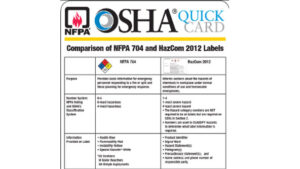
New NFPA and OSHA HazCom 2012 Quick Card
The NFPA has posted a new Quick Card to its website to help users quickly compare NFPA 704 with OSHA’s HazCom 2012. Made in partnership with OSHA, it provides side by side information about the two systems. The need for the card grew out of OSHA’s adoption of GHS in March of 2012 which concerned […]

Acetone: The Hidden Hazard
What Is Acetone? Acetone, also known as propanone, is a clear, colorless liquid that is highly flammable. It is not necessarily a household word, but this will ring a bell: nail polish remover. Acetone is also used as a degreaser, for thinning fiber glass resin, and helps remove adhesives and vinyl resins. While it is […]