











By Phil Molé, MPH
Welcome to the third and final part of our blog series on EHS in Transition, based on the 2026 EHS 360 Benchmark Report.
In Part 1 of this series, we explored the promises (and pain points) that EHS professionals are facing during this era. You learned that EHS professionals are optimistic about the future of their profession, and report that they’re increasingly getting a seat at the table when it comes to major business and risk management decisions. At the same time, they’re also dealing with rising stress, increasing regulatory complexity, and persistent challenges around resources and data.
In Part 2, you learned how organizations are responding to these challenges. Many are investing in technology, modernizing their EHS programs, and exploring how AI can help them overcome longstanding obstacles. Even so, gaps remain, and many respondents report that they haven’t yet fully integrated their tech stack. Many also report the need to establish a company-wide safety culture as a primary goal, another way of indicating they don’t have this type of culture now and have work to do in adopting a proactive safety management approach.
But that last part raises an important question: What does proactive safety actually look like in practice?
It’s one thing to talk about moving from reactive to preventive safety management. It’s another thing to see it happening. Is there a way we can get that level of insight?
That brings us to the final installment of this series, which highlights proprietary benchmark data. Alongside survey responses from more than 1,000 EHS professionals, the 2026 EHS 360 Benchmark Report also examined aggregated, anonymous usage data from organizations using VelocityEHS software. The result is a unique view into how safety teams spend their time, what activities they prioritize, and how they are using technology to support proactive risk management.
Proactive Organizations Generate More Signals
Before diving into the benchmark data, it might help to set the table with information about what distinguishes proactive safety management from reactive safety management, and how those differences manifest as differences in data.
One of the clearest differences between reactive and proactive safety programs is the type of information they collect. Namely, reactive organizations tend to focus primarily on incidents after someone has already been hurt, or lagging indicators.
Proactive organizations look for warning signs much earlier. That’s why they follow a balanced metrics approach that includes tracking leading indicators, which follow activities that likely support primary safety objectives, such as reducing numbers of injuries.
Companies who use this approach actively encourage employees to report:
- Near misses
- Hazard observations
- Unsafe conditions
- Opportunities for improvement
In other words, they generate more signals, particularly signals that help proactively find and address risks before injuries happen.
Technology Helps Drive Maturity
A lot of EHS professionals would like to take on more proactive tasks, but it’s often easier said than done, especially if they lack tools to support completion of additional safety activities.
That’s one reason the VelocityEHS benchmark data is so interesting.
We looked at incident management and risk management software usage. For the EHS 360 Benchmark Report, we defined an incident an event in which an injury or some other type of harm occurred, such as equipment damage. A near miss is defined operationally as an incident in which something unplanned happened, but there was no injury or damage this time.
Our review found that over a one-year period:
- Users tracked 21,496 near misses. This is more than two-thirds of the number of reported incidents (31,813). The number of near misses is also more than 5x the number of recordable incidents (incidents that met more than one recording criteria under the OSHA Recordkeeping Standard), which is impressive because employers are required to track recordables.
- Users completed 2,681 observations/customer, which is 1.78x the number of inspections. This is also impressive because inspections are considered table stakes in EHS management and often are regulatory driven.
- Users completed 125,640 hazard identifications, which is multiple times over the number of near misses and recordable incidents. Because hazard IDs are risk assessment activities, this shows that users were prevention focused.
The most striking number is the volume of hazard IDs. Organizations reported nearly four times as many hazard identifications as incidents. That’s significant because hazard IDs represent risks identified before someone gets hurt.
Put another way, every hazard identified and corrected is a potential incident prevented. Similarly, every near miss investigated is an opportunity to learn without paying the human cost of an injury.
For years, safety professionals have talked about the importance of leading indicators. These findings provide a real-world example of what that looks like in practice.
These proactive measures also directly support continuous improvement, which is a process of reviewing safety performance to find opportunities to improve. Continuous improvement is a hallmark of multiple ISO standards, including ISO 45001, the international standard for occupational health & safety (OH&S) management systems.
It seems to follow from these numbers that users can complete more proactive safety tasks because the software supports this. When it’s hard and time consuming to complete near miss reports, safety observations and hazard IDs, EHS professionals are much less likely to complete them.
One of the main takeaways from my own time as a former Global EHS Coordinator is that for safety to be sustainable, you must make it easy for people to do the right things. The right EHS software can do exactly that.
The Real Challenge: Following Through
Of course, identifying risks is only part of the equation. The harder part is doing something about them. This means developing, tracking and completing an action.
Anyone who has worked in EHS knows that one of the biggest challenges isn’t finding actions to complete. It’s keeping up with all of them.
Think about the fact that so much of what an EHS professional does everyday results in actions to manage. For example:
- Inspections generate actions
- Audits generate actions
- Incident investigations generate actions, whether for occupational injuries and illnesses or for near misses
- Safety meetings generate actions, as employees raise concerns about hazards and risks
Before long, organizations can find themselves managing hundreds or even thousands of corrective actions simultaneously. As a result, they often struggle to complete actions in a timely manner, and often have action completion rates hovering around 50%, or even lower.
That’s why one data point stood out in the VelocityEHS usage data: Organizations completed approximately 74% of actions on time.
Is there room for improvement? Absolutely. But the larger takeaway is that these organizations are actively working through substantial volumes of risk reduction activity, more successfully than many of their peers.
This is what proactive safety looks like. It’s not a single initiative. It’s the daily discipline of identifying issues, assigning ownership, and following through consistently.
AI Adoption Is No Longer Theoretical
The benchmark data also provides a glimpse into an issue that came up repeatedly throughout the survey results: AI.
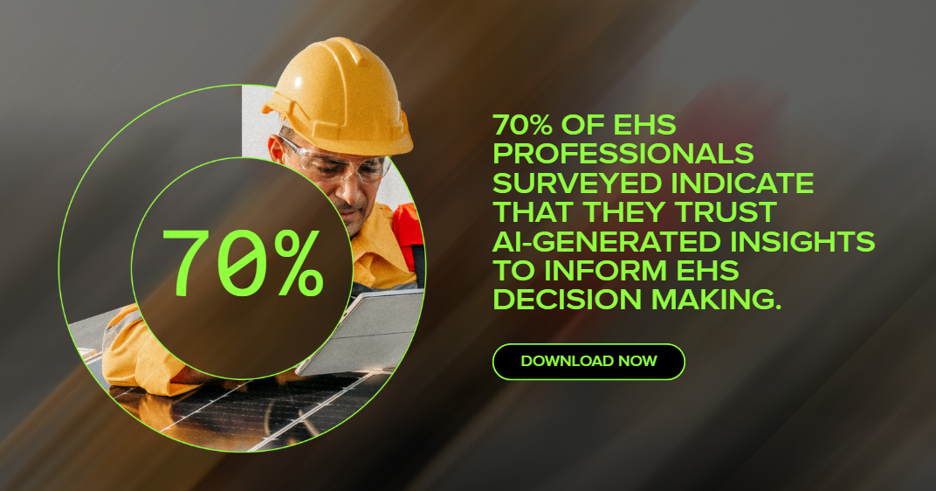
Respondents in the EHS 360 Professionals Survey perceived AI as one of the most transformational forces impacting EHS. And perhaps because of this perception, they identified AI fluency as one of the most important skills EHS professionals need in the coming years. Most EHS professionals also trusted AI to deliver accurate insights to inform their decision-making.
For these reasons, we sought insights from our internal data about whether our own customers use AI capabilities in the software.
One of the most interesting findings in our data was that companies who have the AI overwhelmingly use, and use it quite frequently, at that.
Among organizations with access to AI-powered incident management capabilities:
- 98.9% used the AI Description Analyzer, which assesses the quality of an incident description and recommends improvements. This is an important feature, because without a good incident description, you won’t be able to do effective root cause analysis and won’t identify effective corrective actions.
- 81.3% used AI PSIF Insights, which identifies potentially severe injury or fatality (PSIF) risks from incident descriptions, even within the details for less severe incidents such as near misses.
And they weren’t using them occasionally. The data shows almost 59 description analyses per customer, and over 26 PSIF determinations per customer.
That level of adoption says something important because organizations would only be using these AI features so often if they were finding value in them.
If nearly everyone with access to a capability uses it, and uses it often, that’s also usually a sign the tool is solving a real problem. In this case, the problem is one many EHS professionals know well: the inability to have good enough data to provide the kind of solid insights that can help organizations pivot to a more proactive approach.
The specific AI capabilities reviewed in the benchmark data help EHS professionals overcome these challenges in very specific ways.
Why PSIF Identification Matters
Let’s start by reviewing the reasons why identification of PSIF risks can be a game changer for organizations.
Bureau of Labor Statistics (BLS) data shows that rates of severe injuries and fatalities (SIFs) have not declined much during the last 20+ years, even though rates of total injuries have significantly declined in the same period. That fact points to widespread issues in risk identification and management. This is because if organizations were collectively getting better at identifying and controlling risks, they would presumably be getting stronger at controlling the most severe risks. But the data tell a different story.
Historically, organizations have struggled to identify which incidents and near misses carry the greatest potential for catastrophic outcomes. That’s understandable because research indicates that only 20% or less of all incidents carry PSIF risks. Accurately targeting that 20% for follow-up can be a challenge, and subjectivity often gets in the way. Further, as companies gain maturity by tracking near misses, the mountain of data grows, and the task becomes even harder.
The problem is not a lack of effort. The problem is scale.
Most organizations generate more incident and near-miss data than safety teams can realistically analyze in detail. As a result, critical warning signs can be missed.
This is why PSIF identification is becoming such an important area of focus. It also gives insight into why the benchmark data suggests organizations are increasingly using AI to identify higher-severity risks faster and more consistently.
That matters because serious injuries and fatalities rarely appear without warning. The warning signs are usually there. The challenge is to find them before something worse happens.
Technology Doesn’t Create Proactive Safety. People Do.
Looking across all the benchmark findings, one thing becomes clear:
The story isn’t really about software. It’s about behavior.
The organizations generating large volumes of hazard IDs, observations, inspections, corrective actions, and near misses are demonstrating proactive safety behaviors.
The right technology helps, because:
- It makes reporting easier
- It improves visibility
- It supports follow-through
- It helps surface insights
But the real story is the willingness of organizations to create systems where risks are identified, discussed, and addressed before incidents occur.
That’s the difference between reactive and proactive safety management.
From Transition to Transformation
Across this three-part series, we’ve explored a profession that is evolving rapidly. EHS professionals are facing increasing pressure and complexity. Organizations are investing in technology and AI to adapt.
And the benchmark data shows that many are already making progress toward more proactive safety management.
The most encouraging takeaway may be this:
The future of EHS isn’t just about collecting more data. It’s about turning data into action.
The organizations that succeed won’t necessarily be the ones with the most information. They’ll be the ones that can identify risks earlier, engage employees more effectively, and consistently act on what they learn.
That’s what proactive safety looks like. And increasingly, it’s what the future of EHS looks like too.
Make sure you have the right tools to set yourself up for success in the new era of EHS.
Want to See the Full Report?
Download the 2026 EHS 360 Benchmark Report for additional survey insights, benchmark data, and analysis on the trends shaping the future of EHS.