take a look around.
If you’re looking for information about how upcoming changes to OSHA’s HazCom Standard will affect your business and safety management practices, or about the GHS in general, you’ve come to the right place.
As you explore this Resource Center, find details you need about the context and history of the HazCom Standard, the major changes coming because of OSHA’s 2024 final rule, the compliance timeline, and major takeaways about how to prepare. If you’re looking for details about the history of GHS and its global adoption status in different areas, you can find that here, too.
Click on the links below to start exploring and be sure to check back for updates from OSHA about the HazCom changes or about news regarding GHS adoption around the world. Want to see how the VelocityEHS Chemical Management Solution can simplify GHS/HazCom compliance and workplace chemical management? Check out our solutions page to learn more or schedule a demo.
Check out these Quick Links.
GHS Explained
Discover what the GHS is, why it was developed, and how it is used worldwide for hazard communication.
History of GHS
GHS dates back to the 1992 United Nations Conference, where the need was first recognized.
GHS Facts
Find out more about the GHS with our top ten interesting facts.
Background of OSHA’s Changes
Learn about the background of OSHA’s 2024 final rule, including the history and purpose of the HazCom Standard.
Reviewing the Main Changes
Get a comprehensive overview of the major changes to the HazCom due to the 2024 final rule.
Compliance Transition Timeline
Learn the compliance timeline for OSHA’s 2024 final rule for different parties throughout the chemical supply chain.
Glossary of Terms
Visit our glossary page to better understand common technical terminology used in GHS.
Useful Info & Resources
Explore useful GHS information, as well as blog articles, compliance checklists, webinars, guides, and ebooks.
GHS Explained.
What is GHS?
GHS stands for the Globally Harmonized System of Classification and Labelling of Chemicals.
Developed by the United Nations, the premise of the GHS is that existing chemical classification and labelling systems should be harmonized in order to develop a single, globally harmonized system to address classification of chemicals, labels and safety data sheets.
Why have the GHS?
Given the large number of hazardous chemicals in the world, the ability of one agency to effectively regulate them all is impractical if not impossible. In essence, each country or organization is on its own.
Many countries and organizations have established laws and regulations requiring information to be prepared and transmitted through labels and/or safety data sheets to those people using or handling hazardous chemicals.
History of the HazCom Standard Before the First GHS Alignment
The Occupational Safety and Health (OSH) Act of 1970 set the foundation for OSHA as a government agency tasked with protecting workplace safety and health. The General Duty clause of the Act states that “each employer shall furnish to each of his employees employment and a place of employment which are free from recognized hazards that are causing or are likely to cause death or serious physical harm to his employees.”
Over the years, OSHA issued various standards to address specific aspects of occupational safety. The agency knew of many cases of workplace incidents and fatalities from exposure to hazardous chemicals, many of which resulted in part from employees lacking good information about the identity of the chemicals they worked with, the specific hazards they were exposed to, and safe storage and usage practices.
OSHA first issued the HazCom Standard in 1983 to address some of the issues leading to chemical exposure incidents, but at that time, the Standard only applied to the manufacturing sector. OSHA updated HazCom in 1987 to expand coverage to include all industries, and again in 1994 with technical changes and amendments intended to improve compliance with the Standard. HazCom created requirements for chemical manufacturers to determine the hazards of the chemicals they produce, provide material safety data sheets (MSDSs) with shipments, and ensure that every shipped container contains a label bearing hazard communication information. The Standard also created regulatory requirements for employers at workplaces where hazardouschemicals are used to provide employees with access to MSDSs, ensure that all containers containing hazardous chemicals are labeled, develop and maintain a written Hazard Communication Plan containing a chemical inventory list as an appendix, and provide HazCom training to employees.
Still, the HazCom Standard and its first two updates did not solve all the problems limiting HazCom’s effectiveness. For example, chemical manufacturers did not need to follow a standardized format when creating MSDSs, so a downstream user might find emergency response information near the beginning of a document, near the end, or anywhere in between. Since a typical document might be 10 pages or longer, and since users mostly look for emergency response information during an emergency, that variability in the information’s location could create delays at exactly the wrong time and create risks for employee safety. Another problem pertained to variability in hazard pictograms on shipped container labels.
Enter the GHS
OSHA was not the only regulatory agency in the world noticing issues with its existing chemical hazard communication regulations. Stakeholders of agencies around the world aired some of these concerns in 1992 in the United Nations’ (UN) Earth Summit event in Rio de Janeiro, Brazil. As a result, a subcommittee of the UN formed to begin developing a model framework based on recognized industry best practices that regulatory bodies could use to draft or revise their own hazardous chemical regulations. The subcommittee published the first edition of the Globally Harmonized System of Classification and Labelling of Chemicals (GHS) in 2003 and conducts reviews and updates every two years. A specific edition of the GHS is often known as the “Purple Book,” and the most recent version of the Purple Book, the ninth edition, was published in 2021.
We should note here that the GHS is not in itself a law, regulation or mandate. It’s meant to be a guide, or building block, that regulatory agencies can use to create more effective regulations. Therefore, publication of a new edition of the Purple Book in and of itself does not automatically change chemical regulations – each regulatory agency needs to initiate a rulemaking to align with an edition or editions of the GHS.
Because OSHA was involved in the subcommittee’s planning activities from the beginning, they were always going to align with an edition of the GHS at some point. They finally did so when they issued a final rule to update the HazCom Standard in 2012 by aligning it with Revision 3 of the GHS.
OSHA Aligns HazCom with GHS Revision 3
OSHA’s first GHS alignment brough significant changes to the Standard, especially in the areas of hazard classification, safety data sheets (SDS) and shipped container labels.
Hazard classification and hazard pictograms: Chemical manufacturers must use Appendices A and B to classify their chemicals, and Appendix C then tells them how to allocate shipped container label elements based on that classification. Compared with HazCom 1994, HazCom 2012 provides more detail and nuance in its classifications. For example, under HazCom 1994, we just had the single word “carcinogen” to represent known, probable and suspected carcinogens. HazCom 2012 better reflects degrees of harm and established knowledge about carcinogens, dividing them into Category 1 (subdivided into “known” and “presumed” carcinogens) and Category 2 for “suspected” carcinogens.
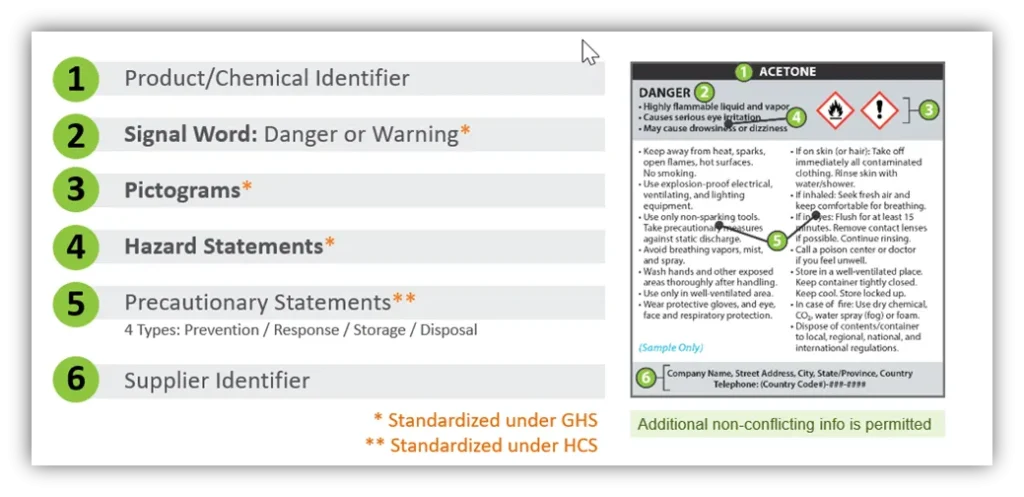
Shipped container labels: The six required shipped container label elements are
1) Product identifier;
2) Manufacturer identification;
3) Hazard statement(s)
4) Precautionary statement(s)
5) Signal word (either “DANGER” or “WARNING,” if warranted based on classification)
6) Hazard pictogram(S)
The image below shows a typical shipped container label containing the six required elements:
SDSs: As discussed above, MSDSs were not as effective as they could have been for communicating chemical safety hazards, because of the variability in how the information within them is organized. HazCom 2012 addressed this issue by adopting the 16-section SDS format(opens in a new tab) from the GHS. All chemical manufacturers must follow this format when creating all SDSs for their products.
The rule had a transition timeline that ran into mid-2016, with extensions provided in cases where upstream delays prevented full compliance. Still, extensions expired over 5 years ago now, and HazCom 2012 has been the “law of the land” in the US since. But that’s starting to change now.
OSHA’s 2024 HazCom Final Rule
The UN published GHS Revision 7 in 2017, and it didn’t take long for OSHA to begin planning to use it as the basis for its next HazCom revision. OSHA mentioned its intention to update the HazCom Standard to align with GHS Revision 7 during public meetings in 2018 and 2019, and in 2020, they included their planned proposed rulemaking on their Regulatory Agenda. OSHA finally published their Notice of Proposed Rulemaking (NPRM) to update the HazCom Standard in the Federal Register on February 16, 2021.
The public comment period for the NPRM ran until May 19, 2021. OSHA also held a public hearing in September 2021 to gather additional commentary from stakeholders on various elements of their proposed changes. But many tentative deadlines came and went before OSHA finally published a final rule in Federal Register on May 20, 2024.
At a high level, OSHA’s final rule brings the following changes to the HazCom Standard:
New Classifications for Aerosols, Chemicals Under Pressure, Desensitized Explosives, and Flammable Gases
The final rule makes several changes to the ways that certain chemicals are classified to align with the classification criteria of those chemicals in GHS Revision 7, or in the case of chemicals under pressure, GHS Revision 8.
Aerosols: OSHA’s final rule is following GHS Rev. 7 (UN GHS, 2017, Document ID 0060) by renaming the existing Flammable Aerosols hazard class “Aerosols” and expanding Appendix B.3 to include non-flammable aerosols, while retaining flammable aerosols. Non-flammable aerosols will now be under a newly created Category 3, while flammable aerosols will continue to be under Category 1 or Category 2.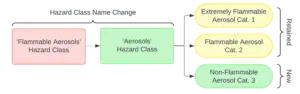
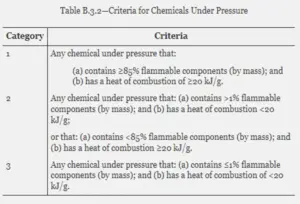
Chemicals Under Pressure: OSHA has adopted a new hazard category, chemicals under pressure, within the aerosols class following classification criteria in GHS Revision 8. These revised classifications also change some associated hazard information, including hazard pictograms and hazard and precautionary statements.
The term “chemicals under pressure” refers to liquids or solids in a receptacle (other than an aerosol dispenser) pressurized with a gas at a gauge pressure of >=200 kPa (29 psi) at 20°C / 68°F. A product classified as a chemical under pressure cannot also be classified as an aerosol, a gas under pressure, or a flammable gas, liquid, or solid. In general, chemicals under pressure typically contain 50% or more by mass of liquids or solids whereas mixtures containing more than 50% gases are typically considered as gases under pressure.
In finalizing the chemicals under pressure hazard classification, OSHA has included all three categories as defined in Table 2.3.3 in Rev. 8 and largely included the hazard communication elements in Table 2.3.4 in Rev. 8 (Document ID 0065, p. 62) in Appendix C.16. The table below shows the chemical under pressure categories and associated classification criteria adopted in the final rule.
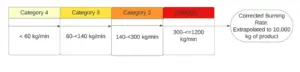
 Desensitized Explosives: OSHA’s final rule is following GHS Rev. 7 (UN GHS, 2017, Document ID 0060) by adding a new physical hazard class for desensitized explosives. There will be 4 categories (1,2,3, and 4) within this new hazard class in new Appendix B.17.
Desensitized explosives are explosive chemicals treated to stabilize the chemical or reduce or suppress explosive properties. To be classified as a desensitized explosive, a chemical must be a solid or liquid, must remain homogenous with its desensitizing/stabilizing agent, and cannot also be classified as an explosive, flammable liquid, or flammable solid.
Desensitized explosives pose explosive-equivalent hazards in the workplace when the stabilizer is removed or inadvertently lost, either as part of the normal work process or when the chemical is stored. Therefore, it is urgent that chemical manufacturers identify and appropriately communicate hazards, including the importance of the stabilizer.
The chart below shows the four categories of desensitized explosives as adopted by the final rule. The “burning rate” in the chart refers to its combustion rate as determined by testing the product in packaging as stored and used. Note that the upper range of Category 1 is 1200 kg/min. This makes sense considering the concept of desensitized explosives, since there needs to be an upper limit on the burn rate of a chemical for it to be able to be stabilized. In the chart, products with a burn rate greater than 1200 kg/min would be explosives.
Flammable Gases: OSHA’s final rule subdivides Category 1 of this hazard class into two subcategories (1A and 1B), requiring pyrophoric gases and chemically unstable gases to be classified as Category 1A. OSHA maintains that these changes will provide more detailed information about flammable gas hazards and align with GHS Rev. 7 (UN GHS, 2017, Document ID 0060). Under HazCom2012, products classified as Flammable Gas Category 1 could have a wide range of flammability properties, so this update to subdivide category 1 will allow more specific and concise hazard communication information relative to a flammable gas’s intrinsic properties.
The image below show OSHA’s updated flammable gas categories and associated hazard communication elements: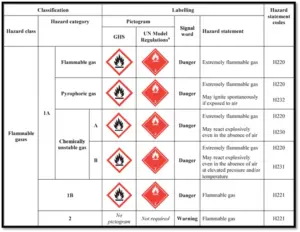
New Labeling Provisions for ‘Small’ and ‘Very-Small’ Containers
OSHA’s final rule incorporates guidance previously provided by OSHA for labeling “small containers” into the text of the Standard, defining a small container as 100 mL or less in volume. Paragraph (f)(12) in the revised standard, addressing labeling of small containers, specifies that chemical manufacturers, importers and distributors can include less information on the shipped label when they can demonstrate that it is not feasible to use pull-out labels, fold-back labels or tags to provide the full label information as required by paragraph (f)(1).
OSHA’s final rule also allows chemical manufacturers, distributors, or importers to provide only a product identifier on “very small containers” (3 ml or less) if they can demonstrate that a label would interfere with the normal use of the container, although they’d still need to include the full shipped container label information on the outer packaging.
However, manufacturers of chemicals in both small and very small containers must include the following information on the label of the immediate outer package:
- Full shipped container label information for each hazardous chemical, and
- A statement that the small container(s) must be stored in the immediate outer package when not in use.
OSHA established these requirements to balance out the allowances for chemical manufacturers to use less information on the immediate chemical container, to ensure that end users can easily access the full range of information normally present on the shipped container label.
Updated Hazard and Precautionary Statements for Clearer, More Precise Hazard Information
OSHA’s final rule revises several hazard and precautionary statements to align with GHS Rev. 7. The rule adds a new paragraph C.2.4.7 noting that “precautionary statements may contain minor textual variations from the text prescribed elsewhere in appendix C (e.g., spelling variations, synonyms or other equivalent terms), as long as those variations assist in the communication of safety information without diluting or compromising the safety advice.”
HNOC Pictogram Allowance
The final rule updates Appendix C to allow the exclamation mark pictogram for Hazards Not Otherwise Classified (HNOCs) to appear on SDSs, and labels. OSHA lays out precedence information when using the pictogram and requires the words “Hazard not otherwise classified” or the acronym ‘HNOC” below the pictogram, if used to denote an HNOC. This allowance reflects OSHA’s agreement with Health Canada to permit exclamation mark pictogram for HNOCs and helps US to better align shipped container labeling with Canada.
Updating Labeling Requirements for Packaged Containers “Released for Shipment”
OSHA’s final rule states that manufacturers, distributors, or importers that become aware of new significant hazard information would not need to relabel chemical products already released for shipment, as previously required.
Over the years, many stakeholders informed OSHA about the difficulty, and danger, of accessing shipped containers that had already been “released for shipment,” meaning they’d been bound together or secured to pallets. Suppose a manufacturer learns of new hazard information about a chemical that’s already been bundled up for shipment into commerce. Employees would need to potentially cut apart binding, climb up onto palletized shipments, and physically struggle to access the shipped labels on individual containers. These efforts could lead to many bad outcomes, including employee injuries or spills of hazardous chemicals. That’s why OSHA proposed to eliminate the requirement for chemical manufacturers to relabel packages released for shipment in their 2021 NPRM. Stakeholders supported this regulatory change, so OSHA made it official in the final rule.
However, OSHA has not finalized its modified requirements exactly as written in the NPRM, and most notably is not requiring a “released for shipment” date on the label. OSHA had originally maintained that requiring chemical manufacturers to provide the date a chemical is released for shipment on the label would allow manufacturers and distributors to determine their obligations more easily under paragraph (f)(11) when new hazard information becomes available. Stakeholders objected, citing practical concerns about lack of space for a “released for shipment” date on the label, costs of updating printed label stock, or how to determine the date to use. Based on this feedback, OSHA dropped the “released for shipment date” label requirement from the final rule.
Labels for Bulk Shipments of Hazardous Chemicals
OSHA’s final rule codifies an allowance for bulk shipments originally provided via a 2016 joint memorandum, clarifying that labels required under OSHA’s HazCom Standard and by Department of Transportation (DOT) Pipeline Hazardous Materials Safety Administration (PHMSA) can appear on the same container.
OSHA and DOT originally issued the 2016 joint memorandum because while both agencies have policies that containers should not be labeled with any labels required by regulatory agencies other than their own, they were aware of situations in which a manufacturer or distributor might want to put both kinds of labels on the same package. For example, a tanker truck or railcar that’s stationary at an employer’s worksite would need to be labeled with HazCom shipped container labels, but the same vehicle would be subject to DOT/PHMSA regulations while in transit. The 2016 joint memo allowed the same container to bear both kinds of labels and the final rule formalizes the allowance within the HazCom Standard.
According to OSHA’s final rule, labels for bulk shipments may be:
- On the immediate container (as shown in the image above), or
- Transmitted with shipping papers, bills of lading (BoLs), or electronic means
Concentration Ranges and Confidential Business Information (CBI)
In the 2021 NPRM, OSHA proposed several changes to paragraph (i) of HazCom, describing the conditions under which a chemical manufacturer, importer, or employer may withhold the specific chemical identity (e.g., chemical name), other specific identification of a hazardous chemical, or the exact percentage (concentration) of the substance in a mixture, from the SDS as a trade secret, or CBI. OSHA proposed to allow manufacturers, importers, and employers to withhold a chemical’s concentration range as a trade secret, which had not previously been permitted, and to clarify that it is Section 3 of the SDS from which trade secret information may be withheld.
After considering all stakeholder feedback, OSHA finalized its proposed CBI changes mostly as proposed but added a new paragraph (i)(1)(vi) allowing the use of narrower ranges than those prescribed in (i)(1)(iv) and (i)(1)(v). The range must be fully within the bounds of a prescribed range listed in (i)(1)(iv) or fully within the bounds of a combination of ranges allowed by (i)(1)(v).
The table below shows the prescribed concentration ranges OSHA is adopting: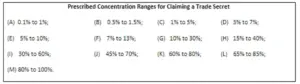
Classification Based on “Intrinsic Properties” and Known or Reasonably Anticipated Downstream Uses
OSHA’s final rule states that, “hazard classification must include hazards associated with the chemical’s intrinsic properties including: (i) a change in the chemical’s physical form and; (ii) chemical reaction products associated with known or reasonably anticipated uses or applications.” The final rule clarifies that hazards from a chemical reaction (the actual GHS-based classifications) belong in Section 2(c) of the SDS, and hazards from changes in intrinsic and physical form belong in 2(a).
Stakeholders during the public comment period for the 2021 NPRM possibly expressed more concerns about this provision than any other, especially because of the NPRM’s original text referencing “normal conditions of use” and “foreseeable emergencies” seemed too broad. Some chemical manufacturers worried that they’d need to factor in every possible downstream use and scenario when classifying a chemical, and that was effectively impossible. OSHA’s updated text in the final rule is an attempt to delineate the narrower expectations for manufacturers to classify chemicals only based on “known or reasonably anticipated uses.”
OSHA provides the following useful summary in the text of the final rule:
“In conclusion, OSHA agrees with commenters that it would not be possible for every manufacturer, importer, and distributor to be aware of every single use or application of its products, and the agency is not requiring these entities to do the kind of intensive investigations that many of the commenters described as infeasible. Additionally, regulated parties will not immediately be aware of all uses when new products are developed or when there are trade secret issues with downstream users. Similarly, OSHA would not expect a manufacturer to know every use of feedstocks (raw materials used to make other chemical products), starting materials or commodity chemicals, solvents, reactants, or chemical intermediates where there could be thousands of uses or the substances are used in downstream manufacturing to produce new chemical products. However, the agency concludes that manufacturers must make a good faith effort to provide downstream users with sufficient information about hazards associated with known or reasonably anticipated uses of the chemical in question. As discussed above, OSHA is finalizing language to make this clear, and to tie the classification obligation to either the manufacturer, importer, or distributor’s own knowledge or facts that the manufacturer or importer can reasonably be expected to know.”
Information Requirements for SDSs
OSHA has updated information requirements for SDSs, including addition of “particle characteristics” for solid products in Section 9 of SDSs.
The 2021 NPRM proposed that only manufacturers of solids would need to include “particle characteristics” information such as particle size (median and range) and, if available and appropriate, further properties such as size distribution (range), shape, aspect ratio, and specific surface area in the SDS. OSHA explained that they were trying to better align with GHS Revision 7, which includes an updated list of physical properties for chemical manufacturers to include in Section 9, and that characteristics such as particle size distribution were important determinants of hazardous properties, since particles less than 100 microns in size carried greater exposure risks, especially through inhalation.
The final rule adopts the “particle characteristics” requirement essentially as proposed in the NPRM. OSHA explained that the Standard does not require chemical manufacturers to conduct testing to determine particle characteristics, and that chemical manufacturers would not need to present particle characteristic information in a specific order.
OSHA’s final rule makes several other slight revisions to Section 9 requirements. For example, OSHA has added a parenthesis stating, “includes evaporation rate” in Section 9 (o), Vapor pressure.
Other minor changes include the term “viscosity” replacing “kinematic viscosity” and “physical state” replacing “appearance (physical state, color, etc.)”
Remember that OSHA has also finalized revised requirements for including hazards due to known or reasonably anticipated downstream uses in Section 2, and has stated that under some circumstances, importers may need to author new SDSs for products from foreign suppliers that didn’t come with SDSs containing domestic supplier contact information. OSHA has also made generally minor modifications to SDS Sections 8, 10, 11, and 14 that create a need for chemical manufacturers/responsible parties to, at a minimum, evaluate SDSs. Altogether, these changes will affect SDSs for many products.
Review Major HazCom Changes.
OSHA published their HazCom final rule on May 20, 2024, finally ending years of anticipation by stakeholders. Keep reading to learn some of the major changes to HazCom due to the final rule and check back often for updates.
The ComplianceTransition Timeline.
OSHA has extended the timeline for compliance with the final rule, compared to the timeline originally proposed in the NPRM. The proposed phased-in compliance timeline had been 1 year for manufacturers of substances and 2 years for manufacturers of mixtures. Between the effective date and the respective compliance dates for substances and mixtures, manufacturers of chemicals can comply with either the previous version of the HazCom Standard or the revised Standard when classifying their chemicals, authoring SDSs and labeling their shipped containers.
Based on stakeholder feedback, OSHA has lengthened the timeline in the final rule to 18 months for manufacturers of substances and 36 months for manufacturers of mixtures, as measured from the final rule’s effective date of July 19, 2024. Employers at workplaces using chemical products affected by the final rule would have six months from the manufacturer deadlines for substances and mixtures, respectively, to make any changes necessary to workplace hazard communication practices (e.g., workplace labels, written HazCom plan, and worker training) based on updated chemical hazard information provided by their suppliers.

Big Takeaways on HazCom Changes.
OSHA’s 2024 HazCom final rule represents the first significant update to the HazCom Standard since OSHA aligned the standard with GHS Revision 3 in 2012.
With modifications to existing hazard classifications and labelling elements and the addition of new hazard classes, hazardous chemical manufacturers, importers and distributors in the US will need to re-evaluate the hazards of the products they sell or import into the country to ensure product hazards are classified and labelled according to revised HazCom criteria. This is particularly true for chemicals in the hazard classes of flammable gases, aerosols, chemicals under pressure and desensitized explosives, because OSHA’s changes to hazard classifications directly affect those products.
Therefore, many SDSs and shipped container labels for chemicals impacted by the proposed changes will need to be re-authored to reflect changes in chemical hazard classification or mandatory labelling information and ensure compliance with updated requirements. Specific industry sectors identified by OSHA as affected by these changes include chemical manufacturing, oil and gas extraction, and plastics and rubber products manufacturing will be more significantly affected by these classification changes. All chemical manufacturers will also need to prepare for the new shipped container label allowances and requirements for small and very small containers. In the final rule, OSHA estimates that 94.4% of SDSs and 64% of labels (non-small/very small) will need revision.
However, all users of hazardous chemicals throughout the supply chain will be impacted by these changes, too. Employers at facilities where these chemicals are used and stored will need to be aware of the changes to classifications and associated information, such as hazard pictograms, hazard statements and precautionary statements, and use the updated information on workplace container labels. They may also need to update their written HazCom plan to reflect the new information, and update the HazCom training they provide to employees who work with hazardous chemicals.
The preparation starts with understanding your chemical inventory, and knowing whether you have chemical products affected by the coming changes. You’ll also need simple and time-efficient ways to manage your SDS library as new documents arrive, and to provide your workforce with barrier-free access to SDSs during their workshift.
No matter where you are in the chemical supply chain, VelocityEHS can help you. Chemical and SDS management capabilities in our Safety Solution, part of our Accelerate Platform®, can help you maintain an up-to-date chemical inventory and SDS library, and provide access to all of your SDSs from anywhere using a mobile device. We can also help you quickly print workplace container labels containing hazard communication information from your current SDSs. And if you’re a chemical manufacturer, importer, or decide to create your own SDSs and labels, the authoring and regulatory consulting services provided by our in-house experts will help you create SDSs and shipped labels that reflect the latest HazCom changes before the compliance deadline.
Contact us today to learn more about how we can help you be safer and more sustainable.
get GHS Resources at your fingertips.

eBook
A Deeper Dive Into Osha's Final Rule Updating The Hazcom Standard
This eBook will help you understand the HazCom final rule and prepare to meet updated requirements.
Infographic
Five Steps To Hazcom Compliance Infographic
Our infographic covers every step you need to take to keep your wor…
Read More
Blog
A Closer Look at OSHA’s Final Rule Updating the HazCom Standard
Here’s a closer look at OSHA’s final rule updating HazCom, and how …
Read MoreLinks to Useful Information
United Nations
- Eighth Revision of the GHS
- Seventh Revision of the GHS
- Third Revision of the GHS
- World Adoption Information
OSHA
- OSHA: Hazard Communication Page
- Revised HCS Regulatory Text
- OSHA Questions and Answers on HazCom 2024
- OSHA HazCom 2024 Fact Sheet
- OSHA Fact Card on Safety Data Sheets (pdf)
- OSHA Fact Card on Labels (pdf)
- OSHA Fact Card on Pictograms(pdf)
- OSHA HCS FAQs
- Compliance Deadlines
- Revised HCS Appendix C (Labels)
- Revised HCS Appendix D (Safety Data Sheets)
EPA
US DOT
US Consumer Product Safety Commission
Canada
- Health Canada: GHS
- Canadian Centre for Occupational Health and Safety (CCOSH) WHMIS Page
- Amendments to Hazardous Products Regulations (2023)
Australia
New Zealand
EU
- UNECE About GHS
- European Chemicals Agency (ECHA) Understanding CLP Page
- 2023 Delegated Regulation Updating CLP
- REACH regulation
- European Commission on Enterprise and Industry
- Health and Safety Authority – Ireland
- OECD (pdf)
United Nations (UN)
Ready to see VelocityEHS in action?
Request a live demo today and see how VelocityEHS can drive impact and protect your people, faster.