






By Phil Molé, MPH
Most organizations don’t struggle to collect safety data. They struggle to use it to prevent incidents.
Every day, safety teams capture incident reports, investigate near misses, document corrective actions, and complete risk assessments. Yet too often, these activities happen in parallel rather than together. Incident management looks at what went wrong. Risk assessments, including job safety analysis (JSA), try to prevent things from going wrong in the first place. Too often, these key safety management tools live in separate domains instead of driving a stronger, more proactive safety strategy.
The organizations with the most proactive safety management find ways to connect those dots. By linking incident management and Job Safety Analysis (JSA), they create a continuous cycle of learning and prevention that helps them identify risks sooner, apply lessons more consistently, and reduce the likelihood of future incidents. And with AI helping uncover patterns hidden within growing volumes of safety data, that connection is becoming easier, faster, and more impactful than ever.
Every Incident Tells a Story
The old saying goes that “every picture tells a story,” a nice bit of wisdom that doubles as the title of a great Rod Stewart album from the early ‘70s. But in safety management, every incident tells a story, too.
We just don’t always listen.
Sometimes it’s a near miss that reveals a hidden hazard. Sometimes it’s an injury that exposes a gap in a process. And sometimes it’s a recurring issue that signals a larger risk hiding in plain sight.
The challenge isn’t collecting these stories. Most organizations already have years of incident reports, investigations, corrective actions, and near-miss data. No, the challenge is to learn lessons and then leverage them to inform a prevention-focused safety strategy.
Incident Management Reveals Where Risk Exists
Every safety program depends on learning from experience.
Incident management provides the structure for capturing and investigating workplace events, from minor near misses to serious injuries. Through incident investigations, organizations can identify contributing factors, uncover root causes, and then determine corrective actions to address identified risks.
Of course, incident investigation and documentation are also sometimes requirements under regulations such as the OSHA Recordkeeping Standard in the US. Employers covered by the standard must document all occupational injuries and illnesses that meet one or more recording criteria on OSHA Forms 300 and 301, and also complete and sign a copy of the OSHA Form 300A summary every year and post it in an accessible location. Some employers also need to electronically submit recordkeeping data to OSHA via the Injury and Tracking Application (ITA).
But collecting data, even as a regulatory obligation, is only the first step.
The whole point of maintaining incident data is so you can use it, to identify and address risks and prevent new incidents from happening. That’s why, for example, OSHA requires employers to include key details about the incident such as a narrative of the events immediately preceding the incident. Too often, employers see the process of documenting the incident with solid details as a “homework assignment,” instead of the foundation for good root cause analysis to identify the underlying, systemic reasons for an incident, and corrective actions selection, where you’ll address the identified risks.
Of course, that’s easier said than done, because subjectivity often looms large when determining root causes, often resulting in selection of old unhelpful root causes like “human errors.” This partly happens because of common misconceptions or inexperience in doing root cause analysis, but sometimes the specific technology used doesn’t help. For example, it may present the user with a long list of possible root causes to consider, but doesn’t rank them in any way, leaving exhausted users to essentially pick a root cause out of a hat.
The time involved is another prohibitive factor, and the rub is that company scale and even safety maturity often add additional challenges. As organizations grow, so does the volume of safety information they generate. Incident reports pile up across facilities, business units, and teams. Valuable lessons can become buried in thousands of records, making it difficult to spot patterns before they lead to another event. Ironically, as organizations gain maturity, they complete more proactive safety management tasks like near miss reporting and generate more data, but more data doesn’t automatically translate into more insights.
A single incident may seem isolated. Across dozens or hundreds of reports, however, recurring hazards and trends often emerge, but you need to be able to see them.
This is where leveling up incident management creates value. It may be reactive in part, because you’re still addressing unplanned events that already happened, but you’re also enabling yourself to gain the insights you need to prevent future injuries and accidents. You’re getting the raw intelligence safety professionals need to understand where risks are developing and where preventive action should be focused.
Incident management with AI capabilities can be a big help here, providing benefits such as:
AI Description Analyzer: AI can assess the strength of your description, and offer improvement suggestions. This is crucial, because gaps in incident descriptions often represent the first point of failure, and all subsequent steps in an incident investigation depend on having a good description.
AI Root Cause Identifier: Using AI, you can accurately identify root causes based on the improved description. The software presents a ranked list, too, so you won’t be left twisting in the wind with a huge list of potential causes and no guidance on which ones to select.
AI PSIF Insights: Only 20% or less of all incidents have PSIF risks, so the challenge is to zero in on that subset so you can prioritize your safety management. The additional challenge is that the process of pinpointing SIFs is time-consuming and fraught with subjectivity, so it’s hard to do at scale, and to apply to all incidents, including near misses. AI PSIF Insights helps overcome that challenge, applying training on huge EHS datasets to correctly identify PSIF risks, even within the details for less severe incidents like near misses.
AI Corrective Action Advisor: After you’ve used AI to improve your incident description and RCA, you can use it to select appropriate corrective actions to address identified risks. Here again, the ability of AI to analyze and identify patterns in huge datasets carries the day, because its selection process is based on much more intensive “experience” reviewing data than most EHS professionals have had.
JSAs are Where Prevention Lives
In our discussion of incident management, you saw how the different elements of investigation get progressively more focused on prevention. By the time you get to corrective actions, you’re expressly trying to apply lessons from the investigation to stop future incidents from occurring.
Still, to have an effective safety management system, you need to go beyond just investigating incidents. You need dedicated safety program activities that are entirely proactive, and all about identifying and getting out ahead of risks.
That’s where Job Safety Analysis (JSA) comes in.
Incident management helps organizations understand what happened. JSA helps them prevent it from happening. Incident management looks backward to understand what happened, while JSA looks forward to assess and control what might happen. The diagram below shows how this relationship plays out in more detail.
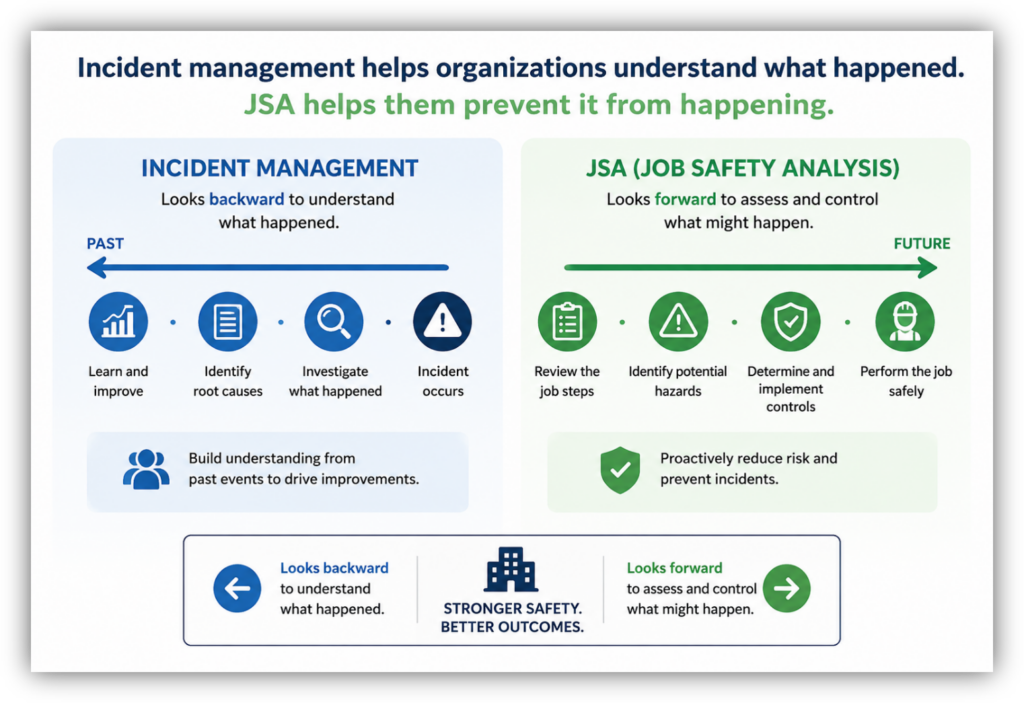
When these processes work together, safety teams can move beyond reacting to incidents and start proactively reducing risk.
A JSA is a type of risk assessment that’s particularly effective because it breaks work into individual task steps, so that potential hazards and risks have fewer places to hide. Once you’ve identified risks, you’re then in a perfect position to establish controls to reduce risks in the job tasks you’ve assessed.
Done well, JSAs help workers understand:
- The hazards associated with a task
- The potential consequences of those hazards
- The controls needed to perform work safely
In many organizations, JSAs are among the most important proactive safety tools available. They create a structured process for identifying risk before an incident occurs.
But like any safety process, a JSA is only as effective as the information behind it.
If hazard identification is incomplete, if controls are outdated, or if lessons from previous incidents never make their way into the analysis, important risks can be missed.
Some of the ways that JSA software with AI capabilities can help include:
- AI Hazard Analyzer: AI can help identify hazards based on the job task descriptions.
- AI Control Recommendations: Using AI, you can select appropriate risk controls for the identified hazards. You’ll even be able to add new controls to your library and build maturity in risk management.
The Missing Link Between Incidents and Prevention
So far, you’ve learned some basics about incident management and JSAs, and why each are important. Now, it’s time to learn something that doesn’t get discussed nearly often enough: incident management and JSAs work best when used together.
The reality is that even today, employers and EHS teams often treat incident management and JSA as separate activities. That’s a lost opportunity.
In the usual scenario, an incident occurs. The employer investigates it. Corrective actions are assigned. The case is eventually closed.
Meanwhile, JSAs continue to be created, reviewed, and used independently. But when you manage these processes in silos, you miss the chance to strengthen prevention.
The lessons uncovered during incident investigations should directly influence future hazard assessments, including JSAs.
For example, if multiple facilities report similar incidents involving a particular task, that information should trigger a review of related JSAs. After all, if an incident involved tasks that have been assessed through a JSA, it’s reasonable to ask if the JSA has gaps that enabled the incident to happen.
When an incident happens, take the opportunity to review all facets of the associated JSA(s), from the job task breakdown and descriptions to the hazard identification, and controls selection, and look for areas to improve. If investigators identify a control failure, that should also affect future JSAs, so that we’re not continuing to use compromised controls on the mistaken belief that they’re delivering the expected risk reduction. You should adopt these practices even in the cases of near misses, since near misses offer a chance to identify and correct risks without the cost of an injury, at least this time. If you have a good process for identifying PSIF risks, perhaps augmented by AI for EHS capabilities, be sure to assess near misses for PSIFs too, so you don’t miss the most impactful opportunities to identify risks and improve risk controls.
Also, make sure that the JSAs are accessible and used in daily safety management. Too often, employers complete JSAs only to file them away, and incident records can provide a clue that JSA accessibility issues are causing safety issues.
The reverse is also true: JSAs should inform incident management.
For example, the corrective actions part of an incident investigation is an attempt to identify and implement measures to reduce the risks (represented by root causes) identified in the earlier part of the investigation. As such, there’s broad intersection with the risk controls identified in a JSA, which are intended to prevent incidents from occurring in the first place.
The takeaway here is that if you’ve selected controls in JSAs that are widely recognized as best practices, and have been reducing risks as much as expected, you should also adopt those controls as corrective actions for incidents related to those job tasks. That way, you don’t have competing or conflicting levels of risk controls, some as part of your JSAs and some put in place as corrective actions and have a more harmonized and effective operational risk management system.
In practice, however, making those connections consistently can be difficult.
Safety teams often manage large amounts of information with limited time and resources. Important insights can remain trapped inside incident reports rather than becoming part of a broader prevention strategy. Worst of all, many EHS professionals
How AI for EHS Software Connects Incident Management and JSA
The right AI for EHS software can help you connect the dots between incident management and JSAs. In the process, it bridges the gap between learning from incidents and preventing future ones.
Rather than requiring safety professionals to manually review years of reports, AI can analyze large volumes of safety data and identify patterns that may otherwise go unnoticed.
As previously discussed, AI capabilities can improve multiple aspects of incident management, from the description to root cause analysis, to PSIF identification, to corrective actions selection. AI can also improve hazard identification in JSAs, and selection of controls. If you have the same purpose-built AI doing all of these things, trained on enormous real EHS datasets, several benefits follow:
- You’ll have a more standardized method for completing these tasks across your organization, taking some of the variability out of the picture.
- Since the same AI is selecting controls for JSAs and corrective actions for incidents based on analysis and interpretation of the same datasets, there’s more likely to be congruency between these risk control measures.
- If you have your incident management and JSA software on a single, unified platform, you’ll have the ability to see the associated data for all of your locations in one place. With advanced reporting and dashboards, you can also make sure that the specific data that’s most important for managing your safety performance is visible and shared with the right people.
As a result, you’ll have faster access to better insights to inform your decision-making.
Tighter JSA and Incident Management Drives Continuous Improvement
When incident management and JSA work together, you’re also better empowered to pursue continuous improvement, a hallmark of effective occupational health & safety (OH&S) management according to international standards like ISO 45001.
Here’s how it can play out:
- An incident occurs.
- The organization investigates the event and identifies contributing factors.
- Those findings inform both corrective actions and JSAs.
- Improved JSAs help workers recognize hazards and apply stronger controls.
- Risk is reduced before the next incident can occur.
- Another turn of the cycle happens, improving risk management and safety performance each time.
AI accelerates this process by helping organizations identify lessons faster and apply them more consistently across the business. Rather than waiting for trends to become obvious, safety teams can proactively use available data to strengthen prevention efforts.
This shifts safety programs from reacting to incidents toward continuously reducing risk.
AI Doesn’t Replace Safety Professionals. It Supports Them.
All that said, let’s clarify one important thing: The value of AI in safety isn’t in making decisions for people – it’s in helping people make better decisions.
Safety professionals bring the expertise, operational knowledge, and judgment needed to understand workplace risk. AI helps them access information faster, uncover patterns more efficiently, and focus attention where it matters most.
In other words, the ideal use of AI is in handling more data analysis and relieving administrative burdens, so safety professionals can spend more time being proactive, and helping everyone go home safely every day.
The goal isn’t to automate safety. It’s to help organizations learn faster, identify hazards earlier, and make more informed decisions before incidents occur.
Learning the Right Lessons about proactive safety management
With AI helping to uncover insights hidden within safety data, organizations can strengthen that connection, continuously improve hazard identification, and take a more proactive approach to safety management.
Just like we said earlier, every incident tells a story, and those stories teach lessons.
The organizations that learn those lessons fastest are often the ones best positioned to prevent future incidents. They’re the ones who’ll no longer need to tell stories about incidents, and the endless cycle of reacting to them, because they’ll be too busy telling stories about proactive safety management, and the resilience it brings.
Ready to Learn How Velocity AI Can Help?
Vēlo, powered by VelocityAI, is trained on real EHS datasets to provide the context-relevance and accuracy you need in your EHS workflows. Whether you’re improving your incident management with AI PSIF Insights, AI Description Analyzer, AI Hazard Analyzer, AI Root Cause Identifier, or AI Corrective Action Advisor, or using AI Hazard Analyzer and AI Control Recommendations to improve your JSAs, you’ll have better insights, faster. And with Advanced Reporting and Dashboards on Accelerate, you’ll have all the information you need most at your fingertips, through a true platform with an integrated user experience.
Request a meeting so you can see the software in action for yourself!