










Ergonomics
579 results

Have Questions about SDSs? Our Sample SDS in the GHS Format is a Great Place to Start!
According to OSHA, over 43 million workers in the United States are exposed to hazardous chemicals in the workplace each year. Employers are responsible for providing these workers with barrier-free access to safety data sheets (SDS) — in their work areas, during their work hours — for every hazardous chemical kept on-site. OSHA’s alignment of […]
Engaging Your Engineers in Ergonomics: A Tough Nut to Crack
Ergonomics is an engineering discipline. The National Institute for Occupational Safety and Health (NIOSH) defines it as “…fitting workplace conditions and job demands to the capabilities of the working population.” Safety professionals apply ergonomics to, among other things, reduce exposure to the risk factors known to cause musculoskeletal disorders (MSDs). Research has proven that sound […]

Leading Measures for Ergonomics
“If you can’t measure it, you can’t manage it.” These are the wise words of Peter Drucker. And they are true for many aspects of life; your personal finances, your career path, operation of a business, and yes even ergonomic improvements. The challenge is using the right measures to drive and manage your ergonomics improvement […]

Is Stretching Effective in Preventing MSDs?
Some organizations rely on stretching, exercise, and conditioning programs (alone or in combination with other interventions) to prevent musculoskeletal disorders (MSDs). This relies on changing the physical condition and capabilities of each individual employee and is heavily dependent on many variables that are outside an employer’s control, including employee willingness, interest, and participation; an individual’s […]

The Overlooked Ergonomics of a Car
What do you look for in a car? Many people look at the size of the engine, some believe luxury is all that matters, and others value the safety features. Auto manufacturers are continuously trying to capture our attention with new features and functions. But what does this do to the ergonomic aspects of a […]

OSHA Form 300A Posting Deadline is February 1 — Are You Ready?
As we approach the February 1 due date for posting OSHA Form 300A as part of OSHA’s Recordkeeping Rule, it’s important to remember the exemptions and requirements that apply. Under the Recordkeeping Rule, covered employers are required to maintain an OSHA 300 Log of serious injuries and illnesses, and also to post a 300A in […]
Participatory Ergonomics Programs – 9 Keys to Success
Participatory ergonomics (PE) programs are a common way to reduce musculoskeletal disorders (MSDs) in the workplace. These programs generally involve developing an ergonomics team that includes members from various departments and levels within the organization. But most importantly, they include those who have first-hand experience with the ergonomic issues: the workers. These teams also include […]

BLS Data Show Decline in Occupational Injuries Requiring Days Away From Work in 2015
New data from the Bureau of Labor Statistics (BLS) show that the overall incidence rate of workplace injuries and illnesses requiring days away from work decreased by 2.9 percent in 2015, with 104 cases per 10,000 full-time workers – down from 107.1 in 2014. The data also suggests an overall decrease in the severity of […]

Health Canada Releases Phase 2 Guidance for WHMIS 2015 Compliance
Suppliers of hazardous chemicals to Canadian workplaces can now access additional guidance for complying with new WHMIS requirements, which were modified in 2015 to incorporate the Globally Harmonized System of Classification and Labelling of Chemicals (GHS). Health Canada has published this new content as Phase 2 of its Technical Guidance on the Requirements of the […]
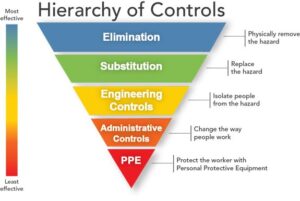
Hierarchy of Controls for MSDs
All good safety professionals know to pursue the hierarchy of controls when eliminating or reducing exposure to safety hazards. The same hierarchy can be applied to managing and controlling the risk factors which cause musculoskeletal disorders (MSDs). The proof and effectiveness has been demonstrated in several recently-published studies. It is interesting to note that there […]