










Regulations & Compliance
708 results

Are You Managing Your EHS Actions, or are They Managing You?
The job of an EHS professional is never over. There’s always work that needs doing, including an ever-growing list of tasks we need to complete to address risks and maintain effective workplace safety programs. Making life more difficult, the work has a way of multiplying. Sometimes, it seems that for every item we cross off […]

VelocityEHS Offers HazCom Support for Emergency Responders, Businesses and Others Affected by Hurricane Dorian
VelocityEHS will once again provide disaster relief to organizations, emergency responders and local businesses affected by Hurricane Dorian through access to its VelocityEHS safety data sheet (SDS) library at no cost. For a limited time, all customers and non-customers located in the storm’s path can visit www.EHS.com/disaster and search through the millions of safety data […]
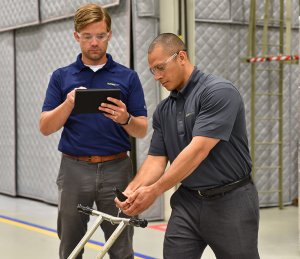
Force Matching: An Alternative Method to Measure Force
The physical risk factors that have been consistently linked to the development of musculoskeletal disorders (MSDs) are posture, frequency, duration of exertion, and force. Recent research indicates that force has the greatest impact on MSD development. This can make it challenging to accurately quantify MSD risk, since force can be the most difficult risk factor […]

Understanding MSD Risk Scoring: Whole Body vs. Individual Body Segment
If you use VelocityEHS’ industrial ergonomics software, this short explanation of risk scoring is worth the read. After sitting in on a client discussion about the difference between whole-body scoring and individual-body-segment scoring, I asked certified ergonomist and member of our research team Rick Barker for clarification. Here’s what he said: The correct question isn’t […]

OSHA and Health Canada Issue Joint Guidance Documents
Occupational Safety and Health Administration (OSHA) and Health Canada have issued three new joint guidance documents to support implementation of the Globally Harmonized System of Classification and Labeling of Chemicals (GHS). They’ve published the documents through the Regulatory Cooperation Council (RCC), which exists to assist companies who may need to manage regulatory requirements from both […]

Preventing Workplace Violence in the Health Care Industry
The U.S. health care industry employs more than 20 million individuals and I’m willing to bet that each and every one of us has a friend or family member who’s worked as a nurse, a doctor, a home health care worker, paramedic or other health care professional. For so many of us, the threat of […]

Protect Workers from Dangerous Temperatures with On-Demand Training
With many locations experiencing the hottest time of the year, it’s important to take the right steps to protect workers from serious health risks posed by exposure to extreme temperatures, such as heat stroke and heat exhaustion. The VelocityEHS Working in Extreme Temperatures training course – part of our On-Demand Training course library – makes […]

The Importance of Management of Change (MOC) in Preventing Chemical Accidents
It seems almost every few months there’s another story in the news about a major chemical accident somewhere in the United States. On June 21, 2019 a major explosion at a petroleum refinery just outside of downtown Philadelphia, PA injured five workers and endangered thousands of nearby Philadelphia residents. The damage was so severe that […]

OSHA Public Meeting Offers Insights into the Future of GHS & HazCom
OSHA and PHMSA recently hosted a public meeting to discuss proposed changes and updates to the GHS in preparation for the 37th session of the United Nations Sub-Committee of Experts on the Globally Harmonized System of Classification and Labelling of Chemicals (UNSCEGHS). During the meeting, OSHA accepted stakeholders’ comments on a series of working papers […]

Introduction to Hazard Communication, Part Six: Overcoming Common Challenges by Putting Your HazCom Program to Work
Welcome to the sixth and final installment in our “Intro to HazCom” series! If you missed our previous posts in this series or want to refresh your memory, just follow the hyperlinks to read about the basics of HazCom (Parts One and Two), the challenges of chemical container labeling (Part Three), the requirements for a […]