








Getting Started
203 results

OSHA Issues COVID Emergency Temporary Standard For Healthcare and Revised Guidance for All Industries
OSHA has issued an Emergency Temporary Standard (ETS) to protect healthcare and healthcare support service workers from exposure to variants of the SARS CoV-2 virus that causes COVID-19. The Federal Register published the ETS on June 21, 2021 and it became effective on the same date. This ETS comes shortly after OSHA also updated its […]

Prevent Incidents Before They Happen: Using a Prevention through Design Framework
Ask most safety professionals, and they’ll tell you: Our goal should be to prevent incidents before they happen. But ask them how, and you’ll probably get many different opinions. It’s fair to say that in the absence of a coherent strategy, many fall back on the reactive approach of addressing risks only after incidents have […]
IH 101 Part 7: Evaluating & Communicating Performance – The Keys to Engagement with Your IH Program
Welcome to our seventh and final installment in our IH 101 series! It’s been quite a journey so far, but we definitely saved the best for last. Last time, in Part 6 of our IH 101 blog series “Medical Surveillance – Strengthening Your Last Line of Defense for Worker Health,” we learned the basics of […]

OSHA’s Proposed Changes to the HazCom Standard
Ever since OSHA published its Notice of Proposed Rulemaking (NPRM) earlier in the year to update the HazCom Standard to align with Revision 7 of the UN’s Globally Harmonized System of Classification and Labelling of Chemicals (GHS), VelocityEHS has received many questions. This is understandable, since this NPRM would bring the first formal revision of […]
IH 101 Part 6: Medical Surveillance – Strengthening Your Last Line of Defense for Worker Health
In Part 5 of our IH 101 blog series “Data Analysis – Defining Your Goals & Selecting the Best Metrics“ we learned about effective tools for analyzing your IH data, and the critical importance of defining the purpose of your data analysis. Just generating a lot of statistics that don’t provide valuable insights is a […]
IH 101 Part 5: Data Analysis – Defining Your Goals & Selecting the Best Metrics
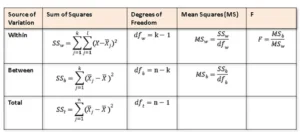
In Part 4 of our IH 101 blog series “Lab Analysis – Uncovering Hidden Gems of Efficiency“ we learned some of the most important factors to consider when selecting a laboratory, and steps you can take to automate the chain of custody (COC) and upload of analytical results from your samples. In Part 5, we’ll […]
SCHC Hosts OSHA Overview of Proposed GHS Revision 7 HazCom Updates
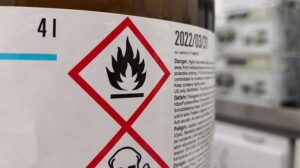
On April 13, 2021 the Society for Chemical Hazard Communication (SCHC) hosted a meeting with OSHA officials to bring stakeholders up-to-speed on the proposed changes to OSHA’s Hazard Communication Standard (HazCom) that were published by the Agency on February 16, 2021. Distinguished presenters included Janet Carter, Senior Health Scientist at USDOL/OSHA, Jennifer Lawless, Senior Industrial […]

IH 101 Part 4: Lab Analysis – Uncovering Hidden Gems of Efficiency
In Part 3 of our IH 101 blog series “Sampling Plans – Moving Beyond Compliance” we learned how to use data obtained during our qualitative exposure assessment (QEA) to help define sampling priorities when establishing your sampling plan. In Part 4, we’ll focus on best practices when working with your IH analytical laboratory to increase […]

IH 101 Part 3: Sampling Plans – Moving Beyond Compliance
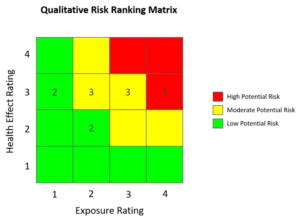
In Part 2 of our blog series on Industrial Hygiene Program Management, “QEAs: The Foundation of a Great Industrial Hygiene Program”, we learned the standard and most widely used methodology for performing qualitative exposure assessments (QEAs). This step of performing the risk analysis is a pre-requisite to developing your IH sampling plans in a way […]

IH 101 Part 2: QEAs – Essential Risk Assessment Methodologies for Industrial Hygiene Program Management
In Part 1 of our blog series on Industrial Hygiene Program Management, “SEGs: The Foundation of a Great Industrial Hygiene Program”, we learned how to create similar exposure groups (SEGs). This step of characterizing your workplace and forming SEGs is a prerequisite for performing qualitative exposure assessments (QEAs). If you haven’t already, we recommend reviewing […]