




By Phil Molé, MPH
In Part One of this series, we addressed six of the most common myths shaping the AI conversation in EHS—from the idea that AI replaces human expertise to the belief that it’s only useful for large enterprises.
The common thread? Most concerns stem from misunderstanding what AI is designed to do in a safety context. In this second installment, we’re tackling five more myths, each one rooted in a very real question EHS leaders are asking right now.
Let’s continue separating hype from reality.
Myth 1: AI Doesn’t Impact Core EHS Management Tasks
One common perception is that AI is a nice-to-have add-on in EHS management, useful for dashboards or executive summaries, but not deeply connected to day-to-day EHS management.
Reality: AI has the potential to directly support core EHS workflows.
Think about the foundational tasks that safety teams manage every day:
- Incident reporting and investigation
- Root cause analysis
- Developing effective corrective actions
- Job safety analyses (JSAs)
- Contractor safety management
- Hazardous chemical management
- Regulatory documentation
AI can accelerate and enhance each of these.

AI can analyze incident narratives to identify recurring contributing factors. It can surface overdue corrective actions that carry the highest risk. It can flag trends across sites that may not be visible in isolated reports. It can help prioritize audits based on historical patterns.
These aren’t peripheral activities. They are the backbone of EHS management.
When AI is purpose-built for safety, it doesn’t just sit on top of your program. It strengthens it from within.
Myth 2: AI Only Helps with Lagging Indicators
Many organizations associate AI with predictive analytics, but still assume it relies primarily on historical, lagging data, like recordables, lost-time incidents, and compliance metrics. While EHS professionals recognize the importance of leading indicators, they often aren’t tracking those indicators with meaningful potential to yield major safety improvements. Part of the reason for this is the difficulty involved in getting and tracking the most relevant data.
The reality is that AI can unlock the value of leading indicators by breaking down barriers in getting the data that matters most.
To understand why, you first need to recognize the difference between leading and lagging indicators and then understand the distinction between effective and ineffective leading indicators.
Lagging indicators tell you what has already happened. Leading indicators help you prevent what hasn’t happened yet. It’s important to understand that not all leading indicators are equally effective, though. OSHA has provided SMART principles for selecting good leading metrics, which translate to:
Specific: Does the leading indicator spell out details on the actions you’ll be taking to improve safety? Details matter most, however, and you won’t likely be able to use leading indicators successfully without that level of specificity.
Measurable: You need to be able to measure and track your leading indicators to assess their impact.
Accountable: Think of “accountable” as a synonym for “relevant.” In fact, think of relevance as the engine of accountability. If you don’t select leading indicators that influence safety outcomes, you’re not going to get the results you’re hoping to see.
Reasonable: Is it feasible to complete the actions your leading indicators say you’ll complete? If not, there’s no point in selecting them.
Timely: Can you measure your leading indicators often enough, with regularity, to spot important trends?
Based on these criteria, you can think about examples of leading metrics that would check all the boxes. One leading indicator would be potential for severe injury and fatality (PSIF) risks.
For one thing, rates of severe injuries and fatalities have fallen only slightly in comparison to declining rates for all other injuries. This is a good indication that despite the earnest efforts of safety professionals, many significant risks continue to go unaddressed. For another, it can be very hard to pinpoint these PSIF risks within incident data because only 20% or less of all incidents have associated PSIF risk. Those risks also often exist in the records of less severe incidents, including near misses and close calls.
If you could identify and track PSIFs easily, taking subjectivity and time burdens out of the equation, you could track PSIF risk trends over time and confirm that your safety program is identifying and controlling the most significant workplace risks.
In other words, the leading indicator would be as accountable as it can be. It would be timely, it would be measurable, and it would be specific. But it would not necessarily be reasonable because, in the absence of tools, it would be very difficult to assess and track PSIF risks. That’s where AI can help.
AI PSIF identification tools can detect and amplify the signals for high-risk events by analyzing incident records because algorithms are trained on immense sets of real EHS data. With AI, you’ll no longer have barriers to collecting and tracking one of the leading metrics most central to safety improvement.
AI can also analyze or produce data that also can be material for strong leading indicators, including:
- Root cause analyses (RCAs): A root cause is the underlying, systemic reason why an incident happened. You should conduct RCAs for every injury, occupational illness, or serious near miss that occurs, so you can identify and correct the risks that led to them. It follows that the more high-quality RCAs you do, the more positive impact you can expect to make on your safety program. AI for EHS incident management capabilities can improve your RCA through its training on incident data, giving you a more reliable basis for risk reduction.
- Corrective actions: A corrective action is the technical name for what you do to address identified risks, especially those identified through RCA for workplace incidents. AI for EHS capabilities can accurately identify relevant corrective actions based on the improved RCA, and you can then track corrective actions as a leading indicator.
- Job safety analyses (JSAs): A JSA is a risk assessment involving a stepwise breakdown of the tasks involved in a job to facilitate better identification and control of associated hazards and risks. Tracking JSAs can be a great leading indicator, but only if you’re completing JSAs accurately and consistently. For example, similar jobs get assessed with similar risks and corrective actions. AI for EHS can help by assessing job task descriptions and offering improvement suggestions, as well as by identifying hazards and recommending good controls.
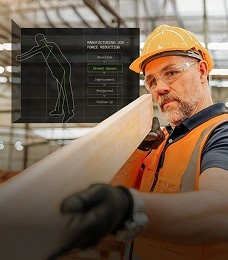
- Ergonomic assessments: Some EHS professionals and facility managers rarely conduct ergonomics assessments, possible due to the perception that musculoskeletal disorders (MSDs) pose little workplace risk. MSDs are not only common, but also are frequently serious, resulting in days away from work (DAFW) or restricted duty cases. AI-enhanced ergonomics software can help you complete 3-D motion assessments for jobs using a mobile device and then offer suggestions for root MSD causes and effective controls via machine learning (ML). You can then track numbers of ergonomics assessments completed, numbers of root causes identified, or numbers of controls implemented as leading indicators because each would have expected correlations with reduced MSD rates.
By improving key safety activities and the data generated from them, AI can facilitate management of better leading indicators you can use to head off emerging risks before they escalate into recordable incidents.
Instead of reacting to injury rates, safety leaders can proactively address trends in unsafe conditions or behaviors.
Myth 3: If We’re Compliant, We Don’t Need AI
Compliance is a baseline requirement in EHS. For many organizations, meeting regulatory standards is the primary benchmark of success. But it doesn’t follow that complying with applicable regulations is sufficient for risk management.
You can find a deeper dive into this misconception and how to move past it in the Leveraging AI in EHS to Move Beyond Regulatory Compliance white paper. In short, some EHS professionals seem to believe that any relevant risks in their workplace are addressed by regulations. This type of thinking leads to the mindset that “If we’re compliant, there’s nothing left to fix and nothing to change.”
The reality is that compliance is the floor, not the ceiling. Regulatory standards define minimum expectations. They don’t guarantee optimal performance. They don’t automatically reduce risk to the lowest achievable level, and they certainly don’t ensure operational excellence.
AI helps organizations move beyond check-the-box compliance toward continuous improvement. It can bolster incident investigations and JSAs and provide actionable intelligence from ergonomics assessments. It can pinpoint chemical ingredients in your products posing specific concerns, including chemicals on specific regulatory lists, and evolving concerns, such as poly and perfluoroalkyl substances (PFAS), or flag PSIF risks obscured within the details of near misses and close calls.
Compliance keeps you within regulations. AI can help you move beyond them and build resilience.
Myth 4: AI Makes Safety Less Human
This myth strikes at the heart of EHS culture. It’s also related to some of the earlier myths discussed in this blog series, including the idea that AI is a black box. An opaque process that generates outputs from inputs in a process that seems mysterious.
Because of that opacity, EHS professionals may doubt they can trust AI outputs, especially when worker safety is at stake. That fear and uncertainty also make the whole process seem cold, or less human, which further adds to the mistrust and unwillingness to adopt AI.
It’s easy to empathize with these concerns, especially considering that protection of people is the whole reason EHS professionals do what they do. Safety is personal. It’s about people going home safely. It’s about trust between frontline workers and leadership. The fear is that introducing AI will make programs feel automated, impersonal, or detached. With all that said, the reality is that when implemented thoughtfully, AI can make safety more human, not less.
Think about this: By reducing manual data analysis and administrative burden, AI gives safety professionals more time to engage with people on the floor. Instead of spending hours collecting and analyzing data or processing contractor documents, teams can:
- Coach supervisors
- Lead safety conversations
- Reinforce positive behaviors
- Strengthen safety culture
AI handles data-heavy lifting, so humans can handle relationships.
In fact, AI can surface insights that help leaders maximize protection of human life, such as by detecting PSIF risks, or flagging chemical ingredients with high risks. It’s also worth pointing out that the best AI for EHS has human subject matter expertise baked in. And human EHS professionals like you still have choices about whether to use or accept the AI-generated insights.
Technology should never replace empathy, and in the best AI for EHS capabilities, it doesn’t. Instead, it carves out a space for more of it.
Myth 5: We Can Wait to Adopt AI Because It’s Still New
AI can still feel like an emerging trend: Something to monitor, but not to urgently prioritize. Some organizations assume they can afford to wait until technology matures. The reality is that AI adoption in EHS is already underway, and the competitive gap is widening.
VelocityEHS is seeing this happen in real time in the surveys conducted on perception and adoption of AI by EHS professionals. In August 2025, 70% of EHS professionals reported at least some usage of AI in their workflows.
But full survey results from late 2025 show that overall adoption of AI increased by 26% and is now nearly universal among the survey population. One clear implication of these findings is that AI adoption for EHS isn’t future tense. AI is already here, and the urgent corollary is that if you’re not already using it, you’re already behind your peers.
The good news is that there’s a real opportunity to catch up and even get ahead of many EHS professionals who are already using AI. That’s because while many EHS professionals are using AI, they’re still not using it for EHS-specific use cases.
EHS professionals in our survey self-report using mostly commercially available general-purpose AI tools like ChatGPT or AI features within office software, such as Microsoft. Most frequently, they use them for drafting reports or summarizing data. However, the use cases discussed here, including PSIF detection, strengthening incident descriptions, providing better RCA, and selecting more effective risk controls in ergonomics assessments and JSAs, represent the most substantial opportunities.
By adopting best in class AI for EHS, EHS professionals can:
- Identify and control risks earlier, including some of the most severe workplace risks
- Reduce time spent on manual analysis or admin time, such as the time needed to extract chemical ingredient information from SDSs, or to process contractor documentation
- Access, via reporting and dashboards, the insights and metrics most useful for better, more impactful decision making
- Move from a reactive management approach to a proactive approach that builds and sustains resilience.
As mentioned earlier, serious injury and fatality rates in many industries have stayed stubbornly high. Traditional approaches alone are unlikely to drive the next step-change improvement, but AI capabilities can be a difference maker.
With the stakes high, waiting doesn’t pause risks. It simply delays potential progress. AI doesn’t need to replace your current program. It can start by enhancing it, incrementally, strategically, and responsibly.
From Myth to Measurable Impact
Across both parts of this series, one theme stands out: AI in EHS is not about replacing professionals, chasing trends, or automating safety culture. It’s about enabling better decisions, faster insights, and stronger prevention.
It’s about giving safety leaders the clarity and confidence to act before small risks become serious incidents.
The myths surrounding AI often focus on loss of control, loss of humanity, or loss of relevance. The reality is the opposite: when designed and governed properly, AI strengthens the role of the EHS professional.
Looking for More Information About AI in EHS?
Stay tuned for more data and insights from VelocityEHS. In the meantime, check out other AI in EHS resources on demand, including:
- Leveraging AI to Move Beyond Regulatory Compliance
- Five Use Cases for Vēlo
- EHS Software AI Capabilities & Vendor Evaluation Checklist
- AI in Safety Coffee Chat series
- Why EHS Professionals Can’t Afford to Ignore AI
Also, make sure you follow our blog for more information on the latest EHS news and insights.
Ready to See AI in Action?
VelocityAI capabilities are purpose-built for EHS, designed to integrate with core workflows, surface actionable insights, and support safety leaders in driving measurable outcomes.
If you’re ready to move beyond myths and explore how AI can elevate your EHS program, VelocityEHS can help you take the next step, with purpose. Reach out to us today to set up a meeting so you can see our capabilities in action.