








The High Cost of Hand and Wrist MSDs
Musculoskeletal disorders (MSDs) of the hands and wrists remain one the most persistent and costly injury types in industrial work settings. One example is carpal tunnel syndrome (CTS). CTS is one of the most common MSDs, affecting 7.8% of industrial workers, noted in a large research study. Direct medical treatment costs for CTS are estimated to exceed $2 billion annually. When indirect costs, such as lost productivity, restricted duty, absenteeism, job reassignment, and turnover are included, the financial burden rises exponentially.
The operational impacts of hand and wrist MSDs are equally stark. According to National Safety Council analysis of BLS data, U.S. employers recorded:
- • 25,680 MSD-related wrist injuries requiring days away from work (DAFW), representing 44% of all work-related wrist injuries between 2023-2024.
- • 13,970 MSD-related hand injuries resulting in DAFW, representing 5.9% of all hand injuries recorded in the same period.
In virtually every occupation, if workers suffer hand or wrist injuries, they simply can’t work. Based on the National Safety Council data, hand and wrist injuries resulted in 15 DAFW per incident, while Days Away, Restricted or Transferred (DART) cases averaged 25 days. For organizations operating in industries with repetitive, manually-intensive processes, these statistics represent more than numbers. They represent lost productivity, rising costs, and preventable risk.
The persistence of these injuries has highlighted a critical gap in ergonomics process management. Traditional assessment methods are labor-intensive, inconsistent, and difficult to scale across enterprise operations. It is this gap that has driven VelocityEHS to invest in AI-powered ergonomics innovation as a strategic response to a long-standing industry challenge.
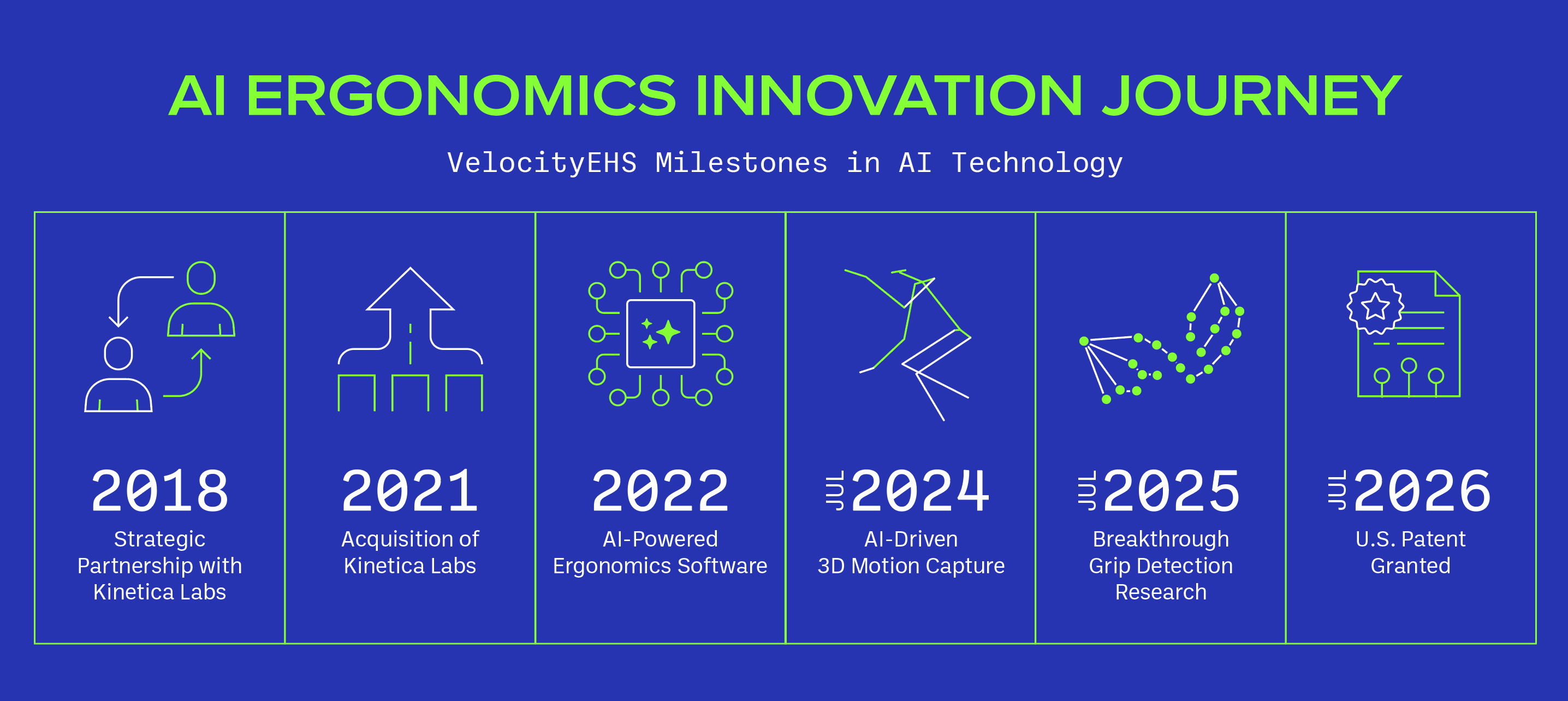
From early motion capture technology partnerships to patented AI-driven 3D motion capture analysis, breakthrough hand grip research and beyond, each advancement has moved forward the science and practice of ergonomics and supported EHS professionals to move from reactive assessment and control toward prediction and prevention.
The Challenge in Quantifying MSD Risks to Hands and Wrists
Safety leaders and ergonomics professionals are keenly aware of hand and wrist MSD risks, but efforts to address and prevent them are often overlooked or challenging to address. This is largely because MSD risks for hands and wrists injuries have historically been difficult to quantify, especially at scale.
Manual methods of observation and assessment require significant amounts of time and ergonomics expertise. Even then, assessment results can also display high levels of variability depending on who is performing them. Without reliable data, it becomes even harder to prioritize risks, select the most effective controls, and justify investment in job improvements. VelocityEHS is changing ALL of this.
Turning Ergonomics Insights into Action
VelocityEHS has been at the forefront of ergonomics innovation for decades. And in the past several years, has led the way in human-centered AI. VelocityEHS Ergonomics software empowers organizations to take advantage of AI-driven risk analysis and move from assessment to action, fast. This means leveraging:
- • AI-powered insights that turn assessments into clear, actionable priorities without the need for extensive ergonomics expertise
- • AI root cause analysis that enables ergonomics programs to assume a proactive rather than reactive approach for addressing MSD risks
- • AI-suggested improvements that tap into deep expertise from our in-house professional ergonomists and proven MSD risk controls
Before examining how VelocityEHS is solving the challenge of MSD risks for hands and wrists, let’s look back at how previous ergonomics innovations are influencing technological advances today.
Strategic Partnership with Kinetica Labs | 2018
The VelocityEHS AI journey in ergonomics formally accelerated in 2018 through a strategic partnership with Kinetica Labs, a group with roots at the University of Michigan and focused on video-based, sensorless motion capture, and advanced computer vision.
As early as 2015, Kinetica Labs was developing groundbreaking technology capable of capturing human movement using standard RGB video, eliminating the need for wearable sensors or laboratory-grade motion tracking systems. The partnership focused on integrating this AI-powered motion capture technology into VelocityEHS Industrial Ergonomics software, combining biomechanics expertise with emerging machine learning models.
At a time when most MSD risk assessment tools relied on in-person observation and manual scoring, the Kinetica Labs partnership positioned VelocityEHS at the leading edge of AI-driven movement analysis.
Accelerating Artificial Intelligence in Ergonomics | 2021
VelocityEHS solidified its AI foundation with the formal acquisition of Kinetica Labs in 2021. This acquisition accelerated the integration of AI into ergonomics workflows and enhanced automated movement analysis capabilities. It also enabled real-time video-based posture analysis, expanded simulation capabilities, and established the technological backbone for future AI ergonomics innovations.
Harnessing AI and Machine Learning in Industrial Ergonomics Software | 2022
In 2022, VelocityEHS formally embedded artificial intelligence and machine learning into its Industrial Ergonomics solution as part of the Accelerate® Platform, marking a strategic shift from digital assessment tools to intelligent, process-based ergonomics systems. This new capability introduced AI as a practical tool to better predict and prevent MSDs, enhance risk scoring consistency and accuracy, accelerate and simplify assessments, and support enterprise-wide deployment of ergonomics processes.
Launching AI-Driven 3D Motion Capture | 2024
In 2024, VelocityEHS launched its next-generation AI-driven 3D motion capture model, capable of analyzing human movement in three dimensions using standard, monocular video. Powered by deep neural networks trained on extensive motion datasets, the system improved posture detection accuracy, further reduced assessor variability, and enabled scalable, sensorless motion capture for comprehensive ergonomics risk assessment. Recently, VelocityEHS published a peer-reviewed research study titled, 3D Human Pose Keypoints and Corresponding Joint Angle Calculation for Vision-based WMSD Risk Assessments, which details the 3D motion capture data set, model, and validation.
Providing Breakthrough AI Research in Hand Grip Recognition | 2025
In 2025, VelocityEHS published a peer-reviewed research study titled, Vision-Based Computing Pipeline for Recognizing Hand Grip-Types During Tool Handling, which demonstrated successful AI-based hand grip classification using standard RGB video. This research validated the ability of machine learning models to detect and classify grip types, track exposure patterns, and analyze fine motor hand movements, laying the foundation for automated hand and wrist risk detection.
Strengthening AI Innovation Leadership Through U.S. Patents | January 2026
In early 2026, VelocityEHS secured a U.S. patent for its vision-based 3D human pose estimation and ergonomics assessment system. The patent reinforced the proprietary, research-backed nature of VelocityEHS AI-powered ergonomics technology and underscored its long-term commitment to innovation leadership in workplace safety.
Introducing the AI Hands & Wrists Assessment: The Next Evolution in Industrial Ergonomics Technology
The VelocityEHS AI Hands & Wrists Assessment is the first-of-its-kind AI innovation in ergonomics software, designed to transform how organizations assess, prioritize, and control hands and wrists MSD risks.
Using any standard mobile device video, the AI Hands & Wrists Assessment leverages our patented machine learning (ML) technology that is purpose-built to detect fine motor tasks and generate accurate, consistent assessments in mere minutes instead of hours. This marks a giant leap forward in ergonomics program scalability and cost effectiveness, while further expanding the scope and pace of MSD injury prevention.
AI Hands & Wrists Assessment builds on patented technologies and cutting-edge ergonomics research from the team of Certified Professional Ergonomists, AI data scientists, and in-house EHS experts at VelocityEHS. This state-of-the-art capability transforms what was once an arduous, manual, and inconsistent process into an intelligent, scalable system that delivers faster insights and earlier interventions.
The AI Hands & Wrists Assessment empowers organizations to conduct detailed hands and wrists MSD risk assessments using standard monocular video, automatically detects and classifies grip types, estimates grip forces, reduces assessment errors compared to manual scoring, and accelerates corrective action prioritization.
Stay Tuned for the Official Launch of the AI Hands & Wrists Assessment
With hand and wrist MSDs continuing to rank among the highest contributors to workplace MSDs and injury costs, it’s essential for EHS professionals and ergonomists to address this critical problem. VelocityEHS is committed to supporting companies in solving real-world challenges and pushing the boundaries of AI in ergonomics risk assessment.
VelocityEHS is excited for the upcoming launch its one-of-a-kind AI Hands & Wrists Assessment, combining AI-driven motion capture technology, peer-reviewed hand strain research, patented pose estimation technology, and enterprise-grade ergonomics software to eliminate the administrative and logistical barriers to comprehensive MSD risk.
If your organization is focused on accelerating MSD risk assessment workflows and strengthening your own hands and wrists MSD prevention programs, there has never been a better time to explore AI-powered industrial ergonomics with VelocityEHS. Keep watching for more information on this exciting release from VelocityEHS. In the meantime, reach out to us for a conversation on this incredible new capability.