










By Phil Molé, MPH
For decades, safety performance has been measured by one simple idea: fewer incidents mean a safer workplace. Lagging metrics measuring numbers and rates of actual injuries and illnesses have become the standard, shaping how organizations evaluate risk, benchmark performance, and make decisions. Even so, serious injuries and fatalities (SIFs) continue to occur at stubbornly consistent rates.
This uncomfortable fact reveals a gap between what traditional safety metrics show, and where the most significant risks exist. This gap is forcing organizations to rethink how safety is measured and managed.
Increasingly, leading companies are shifting their focus toward Potential Serious Injuries and Fatalities (PSIFs), which are events that may not result in severe outcomes, but carry the potential to do so under slightly different circumstances. By identifying and addressing these high-risk scenarios early, organizations can move from reactive reporting to proactive prevention.
But this shift introduces a new challenge.
In Part 1 of this series, we’ll explore the core problem: why SIF rates have remained consistently high, why only a small percentage of incidents carry PSIF risks, and why those critical signals are so difficult to identify within traditional safety data.
We’ll also examine how AI is emerging as a powerful tool to help organizations surface and prioritize these hidden risks at scale.
The Problem with “Good” Safety Performance
For more than two decades, organizations have worked to drive down recordable injury rates. On paper, the progress often looks impressive. TRIR and DART rates trend downward, dashboards turn green, and safety performance appears to improve year over year.
And yet, something doesn’t add up.
Serious injuries and fatalities (SIFs) have remained stubbornly persistent. In many regions, fatality rates have plateaued, and serious injury claims are even rising despite reductions in overall incident frequency.
This disconnect reveals a critical flaw in how safety performance is traditionally measured.
Most organizations are still relying on lagging indicators that prioritize frequency over severity. Metrics like TRIR reveal how often incidents happen, but not how bad they could have been.
Near misses, in which no one was hurt this time, still have major risks behind them. And they will likely go unaddressed due to the lack of perceived urgency. One day, these risks
may manifest into a more serious incident. As a result, companies can appear safe, while still being exposed to life-altering or fatal risks.
The lesson here is that “good” safety performance isn’t good enough, because it falls short on identifying and controlling risks. The risk is that thinking your management system is good enough can keep you from putting in the work to get to the next level. This is probably what business author Jim Collins had in mind when he observed that “good is the enemy of great.” In fact, “good” isn’t even in the same zip code as “great.”
Why We’re Missing the Most Important Risks
There are really three major, interconnected reasons why EHS professionals don’t succeed at identifying and controlling the most severe workplace risks.
The Problems with Heinrich’s Safety Triangle
The long-standing assumption behind many safety programs is rooted in Heinrich’s Safety Triangle, shown in the image below.
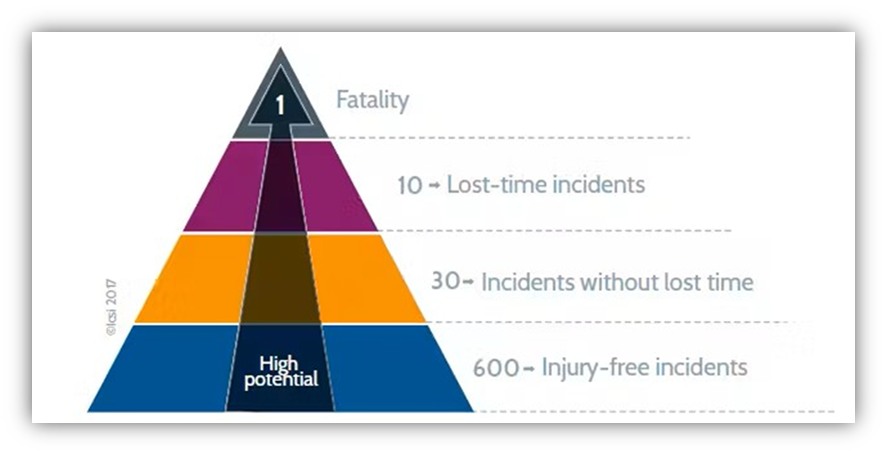
The triangle posits that there is a definite proportion between the numbers of injury-free incidents, incidents without lost time, lost time or days away from work (DAFW) incidents, and fatalities. The follow-up assumption is that if you make progress preventing less serious incidents, you’ll also reduce the numbers of more serious incidents by consistent amounts.
In reality, this relationship is weak. Only about 20% (or less) of lower-severity incidents carry the potential for serious injury or fatalities (SIFs). That means the vast majority of incidents that organizations track and trend are not connected to the outcomes they care about most.
Even more importantly, the causes of SIFs are different. Serious events are typically driven by:
- High-energy hazards
- Weak or missing critical controls
- Complex, high-risk tasks
These are not the same factors behind minor cuts, slips, or low-severity injuries. So, when organizations focus broadly on reducing all incidents, they dilute attention away from the small subset that matters most.
The result?
Plenty of activity is tied up in general injury prevention, but it has a very limited impact on preventing catastrophic outcomes.
The Reactive Safety Management Cycle
Another reason that EHS professionals don’t make enough progress reducing the most serious workplace risks is due to lack of efficient systems and tools. Simply put, it’s hard for EHS pros to get enough done. They have a lot to do, and the tools they have don’t facilitate cooperation with other team members.
Worse, the tools don’t communicate with each other. EHS professionals often have as many ways to do things as they have things to do. For example, their incident records live in a different place than their corrective actions, even when the corrective actions are associated with the incidents.
As a result, they find themselves trapped in the reactive safety management cycle, always focused on follow-up of yesterday’s incidents instead of preventing tomorrow’s incidents.
There are two consequences to this:
A Compliance-First Mindset
There are many regulatory compliance obligations in the EHS world, including widely applicable regulations, including OSHA’s Recordkeeping Standard for occupational injury and illness documentation and reporting, and the HazCom Standard for hazardous chemical management.
There are also consequences for noncompliance, such as formal violations and associated fines. For that reason, it’s understandable that EHS professionals who have a to-do list that never seems to get any shorter would focus on regulatory tasks, especially when you factor in potential pressure and prioritization from management.
Because we all want to believe we’re acting rationally and prioritizing the right things, a narrow focus on compliance tends to justify itself in our minds. In other words, it’s a short conceptual jump from focusing on compliance for pragmatic reasons to believing that compliance is all that really matters. This conclusion is abetted by the perception that regulations address all of the “important” workplace risks, and therefore, if risks are unaddressed by specific regulations, they must not be significant.
The reality is that compliance is just the baseline. While it’s true that regulations exist to address common risks associated with specific job tasks, industries or stressors, like
chemicals or occupational noise exposure, regulations can never address all the specific hazards and risks that may be present across all workplaces.
What’s more, outside of North America, regulatory agencies don’t delineate all or even most workplace risks. Instead, they task employers with the primary responsibility to identify and control workplace risks based on the realization that no two workplaces are alike as prescriptive granularity can go only so far.
What this means, in a nutshell, is that a solitary focus on compliance can easily lead to overlooking major hazards and risks, which can further ensnare you in the reactive safety management cycle. Regulatory compliance is the floor for safety management, not the ceiling.
Loss of Workplace Engagement with Safety Programs
Why does a reactive safety management approach lead to loss of workplace engagement in safety? It’s not hard to understand from the perspective of an average employee in the workplace.
Your friends, your co-workers, or maybe you have been injured. But you hear the EHS Department and plant management constantly talk about the importance of safety. Occasionally, you’ve tried to bring hazards and improvement suggestions to their attention. But management seems to spend so much time responding to previous incidents that it doesn’t have time to focus on preventing new ones, which inevitably happen.
Employees caught in this cycle will likely start to feel demoralized and discouraged from trying to participate in safety because their participation doesn’t lead to progress. That’s very harmful to your entire safety program because you need the input of frontline employees who understand the risks of their jobs better than anyone else possibly can.
The PSIF Identification Challenge
Consider this a corollary and a kind of special case of the central problem in the reactive safety management cycle. If only a small fraction of incidents has PSIF potential, the obvious question becomes:
How do you find that subset of incidents so you can address the risks?
This is where many safety programs struggle, because PSIF identification requires:
- Analyzing incident and near-miss data in detail
- Evaluating hazard severity independent of outcome
- Applying consistent criteria across teams and locations
- Prioritizing high-risk events for deeper investigation
In practice, this is incredibly difficult for multiple reasons. It’s not easy to make accurate determinations about whether a specific incident involved PSIF risks, especially if it’s a less serious incident like a near miss. Accurate assessments of PSIF risks need to be based on familiarity with trends from a huge dataset of incidents, their root causes, and the severity of outcomes. And very few people either have that data at their fingertips or have the means to analyze it. In the absence of reliable objective methods, subjectivity reigns.
Even when the data exists, identifying PSIFs depends heavily on:
- The quality of incident descriptions
- The experience of the reviewer
- Time and resource availability
Ironically, building EHS management maturity does not necessarily fix these problems, because maturity is built in part on larger, better datasets. Mature organizations, as a result, often have too much data: thousands of incident reports, near misses, and observations, but limited ability to extract meaningful patterns. On the flipside, less mature organizations may struggle with underreporting, inconsistent data quality, or lack of expertise.
In either case, organizations lack reliable ways to carve into their data and extract meaningful insights on risks, and significant risks remain hidden in plain sight.
How AI Changes the Equation
These are major problems, but they’re the kind of problems artificial intelligence is built to solve.
AI can analyze large volumes of incident and near-miss data at scale, identifying patterns and risk signals that would be much more difficult to detect manually.
For example:
- AI can evaluate incident descriptions to infer hazard severity, even when outcomes are minor
- AI can flag potential PSIF events automatically based on known high-risk conditions
- AI can assess the strength of an incident description and offer suggestions for improvement to reduce the potential to miss key details
- AI can improve root cause analysis (RCA) by finding the causes most likely to be associated with the incident description and surfacing the most relevant ones.
- AI can improve the selection of corrective actions based on the improved incident description and RCA to select actions that are relevant and effective, so you can mitigate the risks involved in the incident
Let’s think about how all of this may work together by examining an example of workplace chemical exposure. Suppose that your initial incident description indicates “worker was sprayed with a chemical.” Is that a PSIF? You don’t know yet because the incident description doesn’t convey enough information. You can engage AI incident management features to assess the description and offer recommendations, and following them, you revise the description to read:
“Worker was connecting a hose to a tank, the hose ruptured, and worker was sprayed by 150°C hydrochloric acid on the face. The worker was wearing the required PPE (hardhat, face shield, goggles, chemical apron, and chemical gloves).”
Now you can engage the AI to conclude if this is a PSIF, and this time, you have enough information for it to make the call. Yes, it is a PSIF because the AI notes the extreme hazard posed by 150°C hydrochloric acid, despite the worker wearing required PPE. Based on its training on incident datasets and EHS context, the AI correctly concludes that exposure could potentially cause severe chemical burns, permanent disfigurement, or even fatal injuries if a similar incident were to occur.
This example highlights a key point: PSIF identification is not about what happened. It’s about what could have happened.
AI helps organizations make the shift toward proactive, anticipatory safety management by:
- Scaling expertise across the enterprise
- Reducing reliance on manual review
- Enabling faster, more consistent decision-making
As you can see in this example, AI doesn’t replace human safety expertise. It enhances it, doing the heavy lifting in data management tasks, so teams can focus on investigation, controls, and prevention.
Moving from Lagging to Leading Indicators
Many organizations associate AI with predictive analytics, but still assume it relies primarily on historical, lagging data, like recordables, lost-time incidents, and compliance metrics. Also, while EHS professionals recognize the importance of leading indicators, they often aren’t tracking leading indicators with meaningful potential to lead to major improvements in safety. Part of the reason why is because of the difficulty involved in getting and tracking the most relevant data.
The reality is that AI can unlock the value of leading indicators by breaking down barriers to getting the data that matters most.
To understand why, we first need a better understanding of the difference between leading and lagging indicators, and the difference between effective and ineffective leading indicators on the other.
Lagging indicators tell you what has already happened. Leading indicators help you prevent what hasn’t happened yet.
It’s important to understand that not all leading indicators are equally effective though. OSHA has provided SMART principles for selecting good leading metrics, which translate to:
Specific: Does the leading indicator spell out details on the actions you’ll be taking to improve safety? Details are critical and you won’t likely be able to use leading indicators successfully without that level of specificity.
Measurable: You need to be able to measure and track your leading indicators to assess their impact.
Accountable: Think of “accountable” as a synonym for “relevant” here. In fact, think of relevance as the engine of accountability. If you don’t select leading indicators that influence safety outcomes, you’re not going to get the results you’re hoping to see.
Reasonable: Is it feasible to complete the actions your leading indicators say you’ll complete? If not, there’s no point in selecting them.
Timely: Can you measure your leading indicator often enough, with regularity, to spot important trends?
Based on these criteria, you can think about examples of leading metrics that would check all the boxes. One leading indicator would be potential for severe injury and fatality (PSIF) risks. Rates of severe injuries and fatalities have fallen only slightly in comparison to declining rates for all other injuries, which is a good indication that despite the earnest efforts of safety professionals, many significant risks go unaddressed.
Further, it can be very hard to pinpoint these PSIF risks within incident data because only 20% or less of all incidents have associated PSIF risk, and those risks often exist in the records of less severe incidents like near misses/close calls.
If you could identify and track PSIFs easily, taking subjectivity and time burdens out of the equation, you could track PSIF risk trends over time, and confirm that your safety program is identifying and controlling the most significant workplace risks. In other words, the leading indicator would be as accountable as can be, it would be timely, it would be measurable, and it would be specific. However, it would not necessarily be reasonable because in the absence of tools, it would be very difficult to assess and track PSIF risks.
That’s where AI can help. AI-supported tracking of PSIFs represents a fundamental shift in safety strategy. Instead of asking the usual questions, like:
“How many injuries did we have?” and “How much money did those injuries cost us?”
Organizations can start asking:
“Where are we exposed to serious risk and are we controlling it?” and “How many serious injury costs did we avoid by addressing risks before incidents could happen?”
This moves safety from reactive measurement to proactive risk management. The same best-in-class AI for EHS software capabilities that make it easy to identify and track PSIFs also provide advanced reporting and dashboards for tracking PSIFs and other key incident management data, which you’ll learn more about next time.
Looking for More Information?
In Part 2 of this series, you’ll learn how organizations can operationalize PSIF insights by:
- Integrating PSIF tracking into dashboards alongside incident, root cause, and corrective action data
- Connecting PSIF trends to control effectiveness and risk reduction
- Measuring the ROI of addressing serious risk exposure
- Building a unified view of safety performance that goes beyond traditional metrics
Be sure to follow our blog for more information about AI and EHS, as well as the latest news and insights about the world of EHS, generally.
Ready to See VelocityAI in Action?
VelocityAI capabilities are human-centered and purpose-built for EHS, designed to integrate with core workflows, surface actionable insights, and support safety leaders in driving measurable outcomes.
There’s never been a better time to check out VelocityAI because Advanced Reporting and Dashboards now can compile data from the AI incident management features, including AI PSIF Insights, AI Description Analyzer, AI Root Cause Identifier, and AI Corrective Action Advisor. They even provide ROI data on addressed PSIF risks.
If you’re ready to explore how AI can elevate your EHS program, VelocityEHS can help you take the next step. Reach out to us today to set up a meeting so you can see our capabilities in action.